Ok – this one is both for my son Zach, and my mom – who both asked about this recipe. Zach is being a huge PIA about it, because the last one I made for him he devoured, so I guess he wants to impress his friends and make one at Auburn…so let’s get on with it.
Beef Brisket is one of the easiest things to make – which rules, because it is delicious.
Ideally, you want to cook a brisket with indirect heat for a long time – I use The Beast (my homemade brick BBQ) and oak/hickory when I can, and they come out truly stellar. But sometimes I am stuck inside, so have to use the oven so this recipe is based on oven cooking. If you can manage indirect heat and smoke, that is WAAAY better – but that is not always so easy to accomplish.
But you can see, a brisket is cut leaving a big layer of fat on one side of it – that little bit of meat crawling over the left here in the pic, is not always there – most times, you see only the white fat there. Unlike other types of meats, you want to leave this fat on there – no need to trim it away…it becomes part of your delicious.
This one is about 2 1/2 pounds – typical for this cut. You can get bigger ones – just be clear on your cooking times, and make sure you block out enough time to do it.
The key in a brisket, is cooking it long and slow – letting that fat melt down into the meat, flavoring and tenderizing it wonderfully. So like many long cooked meats, this one is best served by applying a nice dry rub of spices on it to bring out the flavors and character you are after here.
So the rub I like to use, is based on garlic, onion, salt/pepper, and a little hot stuff. You can make one out of whatever you like (and Zach, the one you want used all of the pictured spices plus some thyme). How heavy you go with any of these, or what kind of blend you create is really the signature of the thing here – because this is all there is to a brisket.
Whatever you choose to blend for your spices, mix them in a bowl so they are well blended.
Now I do have to say, I mixed more than I needed for this one – and should have probably simply taken some of that extra, and saved it for something else – but instead, I used it all.
Once the blend is achieved, rub it into the meat – and I mean rub it in there good. You want there to be no more raw meat or fat showing anywhere – it all needs your spicy goodness.
On the right over here, I have the brisket all rubbed down – you can see how thick I went with it. Do you have to go this far? No – but you do want to cover it well, because a brisket on its own is not the most flavorful thing in the world. And going a little heavy is not usually a problem because you cut it into thin strips – so a lot of seasoning on a little part helps to carry it thru.
But once you have the meat seasoned well, you are almost done with this thing – the hard part is really getting the proper blend of your spices.
The only thing you need to do now, and it is REALLY important – is to make sure the fat side is up – not down. You want that fat to melt, and drip thru your brisket – so having it fat-side up means you are ready to go.
Cooking Your Brisket
Now, my preferred way to cook a brisket (and a lot of other things) indoors, is using my Romertopf clay cooker. It is over there on the left – and like the name implies, is a clay cooker that treats anything inside it really nicely. But Zach doesn’t have one at Auburn, so I decided I would do this is a simple metal roasting pan.
If you are unlucky enough to NOT have a clay cooker yet (eediots!), all you need is a pan big enough to hold it, and some tinfoil to wrap it up tight. Make a good seal around the edges – you are essentially creating a covered dish.
But I don’t even pre-heat the oven for these – I simply put it in there at 275° and let it go.
And yes – I did say 275° – because a low heat is needed to cook it long, and slow. Give it about an hour and a half per pound at that temp. I simply put it in the oven, set my timer, and walk away.
NEVER open the door, or check on it – it is fine, and you don’t want the heat to escape. You don’t baste it, you don’t have to do anything except leave it alone.
Because the one I had was 2 1/2 pounds, I did it for just over 3 hours – at about 280° – because I was timing it for a specific dinner hour. I could’ve gone another hour on it, and it would not have hurt it a bit. But low heat, long time. You go now.
Finishing the Brisket
OK – after all that time, I take off the tinfoil, and I have what is actually a pretty dry piece of meat, and some lovely au jus.
I let it rest for about 10 minutes, then I take the meat to a cutting board, and pour off that au jus into a bowl, and put a ladle in it – I like it just as it is. You could easily make it into a killer gravy by heating it up and adding a roux, but the jus on its own is super flavorful, and perfect as it is.
The last thing (before devouring it) is slicing it – go across the grain, and cut it into thin strips. If there is any fat left from the thick strip after cooking, it will be a thin, seasoned layer – and it is truly wondrous.
That’s it though – slice it thin, serve it with the au jus, and tell ’em Marty sent you. 🙂
I’ve been lucky enough to stay busy doing corporate web writing for over ten years. I started SEO focused writing in 2002, and have been able to see it change over the years due to what Google wants.
You could argue that Google always want the same thing: quality. I think that is too broad a stroke hiding behind too blindingly white of a hat. Don’t drink the kool-aid – it’s spoiled.
My client base has been pretty diverse during the last decade so I have seen what works in different niches and talked to others every step of the way, too. We all usually agree, ranking is simply not that easy and hasn’t been for years – the best sites don’t just rise to the top. And quality is much too cerebral of a concept for an algorithm anyway…it’s a large part of why they relied so heavily on links.
It made me start considering what Google’s influence has done to the niche industry it pretty much created…the one I have been in, happily, all this time.
I started thinking about it all in terms of milestones, and randomly picked four year chunks to grab a little insight into how things have changed, at least as I have seen it go whizzing by from down here in the cave.
2002
When I started, Google was only four, and hardly well known. Not yet a verb. I had been using it since ’99, when a librarian’s aid at college gushed about it, and I too, was a quick devotee. It was awesome.
One of my early copywriting clients at this time sold restored vintage Vespas, and I made his site rank and maintain a top 2 for “Vespa” with very little effort, fighting with Piaggio’s International site for the top spot and often winning it. That I was doing it mostly on-page against a big company was something I noticed immediately (they had a mostly Flash site – ha!), and I began testing the limits of what I could do with it. I was link-stupid, too, which didn’t help…rather, it made me believe that content was king. Because it was.
That was the way it worked then – websites were all built by hand, no real impact from open source yet, so no blogs. Dreamweaver3 was the newest toy and still horribly inconsistent and wrote bloated code. FrontPage sites were all over the place. The ability to rank a site was pretty much synonymous with the ability to build one, which took days or even more.
I cry now, remembering how easy it was to rank…you simply had to have it in the page. If you had competition, a lot of times, you could simply have more instances of the keyphrase, and win – density actually did matter, for a minute. Or, you could use meta tags, titles and copy better than them, and win, which was easy because most sites were built by tech guys who guarded their code ferociously but didn’t care about Google, so biffed it.
It was harder in competitive verticals of course and links were already necessary there – but long tail (still an un-coined term) was amazing, and that included local then too.
No one knew much about the re-born corporate internet. The first bubble-burst was still in the air, many smaller businesses were actually reluctant to get on the web. Money was great (vendors were few and far between), and you could write almost anything and make it work.
In 2002 the web and its technologies were weak but the people in it were generally passionate, so the quality was strong. I was having a blast, personally. I was an official white-hatted Google-phile then, too: a card-carrying sign waver, dyed in the wool and frothing with praise at the mere mention of them.
I was just starting to call myself an SEO copywriter, and no one much knew what it was.
2006
Aging faster than a dog, the web and the writing in it was exploding exponentially. By 2006, two important things were changing everything: ads, and the blogs now holding them.
Open source code made blogging platforms a free way for anyone to get online, and ads made even hollow copy suddenly valuable. A match made in Google’s heaven.
The effect this had on the trade was that the bottom fell out of the market – you could almost hear it whistling past you on the way to the basement. When still virtually anything would work on a page and pages were suddenly free to build, suddenly everyone became an SEO copywriter, too. Lots of them would ferociously undercut norms to get the projects-or simply didn’t know any better and undercharged, because they did it all wrong. Per page and project prices fell thru the floor almost overnight, as did the ability to trust someone brandishing this professional title. Quality was harsh.
Clients started becoming suspicious, because cheap writers were also super aggressive marketers. Seeing pages going for a fraction of normal market prices made lots of business owners blanch, or question established providers (like me!). Cost structures everywhere started to change….affected by the rise of easy.
A page of content was typically boiled down to be just that: a page. Expertise was a tougher sell, because price was immediately understood, quality and depth were more esoteric concepts that were generally only realized in time. Bulk was working a charm in Google, as were more strategic domains (needing filler content), so a lot of people were getting on the web and hiring writers to get them going.
SEO copywriting gigs were most often based on pages churned and words counted, with keyphrases expected in specific densities. Mechanically measured bulk work. That keyword density had already become negated as a true impact was lost on the general public, and many people were using density as a sole measure to determine a page’s value. Ugh.
It was the time of the SEO rockstar, where people were talking about making money everywhere. And they were, even though some claims were no doubt inflated.
Work was everywhere, but suddenly so were self-proclaimed SEO copywriters. Market and quality standards were all over the map. There were still great paying gigs and challenging stuff – but it definitely got harder to find. Word of mouth gigs became cherished because everything public was becoming a zoo, and the monkeys were real turd-flingers.
The web was getting filled by a content is king strategy gone awry. Instead of seeing it as I did, that it meant quality and depth of content trumps all, people applied it with a more-is-better brute force mentality. And Google never stopped them – instead, making it super easy for next to nothing to suddenly start paying ad revenues.
This would continue for years, and the mechanical aspects of deriving web content were proliferating. In this time, it was mostly spun content and mash-n-scraped stuff of a very primitive level, because many people could see that simple noun+verb was all it took to start earning money.
It is fair to say as well, that there were ALWAYS people willing to approach things in a reasonable, clever and calculated way that knew they were never going to find that in a $5 page. But I can also say $5 pages can be stacked into $50/hr jobs, as I saw it done quite often.
The relative ease that was still in the ranking mix made SEO copywriting a pretty coveted thing, and the corporate world started to pay attention to what SEO meant a little more. In-house positions were created, and healthy salaries attached to a lot of them. While there may have been more people claiming to be in the trade and trying for gigs, if you could prove it and handle a meeting or two to explain a spread sheet, you were definitely in demand.
The content in general though, was starting to get thin really fast, because it had better margins for the owner/publishers. It wasn’t limited to any niche or sector – this slow erosion in what went into the page was handed off silently from passionate site owner to opportunistic web builder, and was seen most anywhere, spreading quickly.
People were climbing over each other to get better ranking in Google. Web barons and service shops were proliferating at a rapid clip, and with them is always an opportunity for a writer to get some more work going…I never saw a dip in demand by any means.
2006 echoes to me, of blogs and ads, and the more-is-better concept driving almost everything. Really good time for work – finding it was easy, big fat paychecks were still out there in freelanced corporate gigs, and they even started creating jobs for us and respecting us a bit more. Content was definitely king.
Ironic too, because it coincided with the rise of truly lame, empty-effort webpages in much larger numbers than ever before, with non-writers actively making people start to really distrust a job title being flung around like monkey shit. But there was money changing hands as the cesspool grew, because ads from Google made it all possible. More than that: the money made it pretty attractive.
2010
By 2010, SEO copywriting was a pretty well known idea, even in more common areas. The rise of the job title in corporate circles lent enough credibility to make it a good career. The pay scale ranged based on experience, and a lot of freelance corporate gigs were sucked up by low level in-house SEO copywriters.
I think this was a good thing for most folks because they could get an in-house position where none or fewer had existed before. It made it easier to concentrate on the job itself if you didn’t have to worry about finding the next client, so writing across the web got better in spots as a result, for sure.
Problem was that it had been multiplying in so many places in so many ways, that the bad stuff far outweighed the meaningful stuff just about everywhere. Good sites were certainly out there and getting better all the time but they were typically drowned out by a glut of pushy, thin – but effective – pages spit out by someone trying to cash-in on the professional-in-his-pajamas bonanza.
Google was getting some grief for the rise of all this thin content (the same kindling that fueled their ad sales), so started ratcheting down. Long tail started getting more difficult as every algorithm update seemed to demand more than a thin page to do the job.
The cash flowing into Google was changing it at hyperspeed too – thru acquisitions and internal growth, they were now everywhere with tendrils in lots of pies. In 2002, they were still emerging in to the public consciousness, in 2006, were making an amazing amount of money, and by 2010 they were arguably unlike any company before it in terms of reach, impact, and influence.
Plus, they continually changed their SERPs, so the idea of having a webpage that effectively answered a query was no promise it was going to show above a video, a local result, paid stuff or something else Google put in there in place of the old-fashioned organic results. Complexity was getting even more complex every month.
In terms of the craft, there was of course still a lot of work to do. The onslaughts of cheap writers were still going pretty strong, yet demand for better-than-that was also in play, allowing the median price levels to stabilize.
This was really the last year of a lot of cheap efforts working, so there was about to be a pretty big shake-up…Panda was coming soon. But again, this time period was much like all the others, in that there were good jobs and cheap work out there to do, and you could find both pretty easily. Article marketing, emails, blog posts, ebooks – there was a lot of new types of copywriting coming into the norm, opening up many fun directions.
I did a phenomenal amount of work during this time. I was hooking up folks to gigs, and writers to ongoing client work – it was literally more than I could keep up with many times. It was wonderful though, as it was really kind of cresting – all of these different strategies, working in some degree. It meant lots of stuff to do every day.
I moved my office from my basement to the second floor of my house – and huge windows offering a spectacular view (comparatively) made a nice living analogy of what was happening to me, professionally. The amount of work in 2010 had me considering expansion, and more.
But the scale that everything was moving was soon to be thwarted by years of more intense Google changes – leaving the fate of the SEO copywriter a little less certain than in years gone by…that is, if you haven’t been paying attention.
Wrapping It Up
The one constant I have seen over the decade plus I have been doing this for people, is that there is, and will likely forever be a need for someone who can write well, that also understands a thing or two about optimizing the work for search engines, especially Google. It makes a potent combination in any niche, serving every vertical. It’ll never diminish in value as long as there is some sway.
There is still a glut of folks that call themselves SEO copywriters simply because they have churned out a ton of pages for someone somewhere. And by definition they are – but they are not representative of what I consider an experienced SEO copywriter. They are aspiring copywriters who worked on an SEO project, but there is a big difference between that, and knowing why words should go where they do, or what to do with analytics or how things have changed in the last 18 months. The tactics need to be understood in a larger sense for the smallest pieces to fit.
Success in Google drives a majority of what clients need from an SEO copywriter…it always has, in the decade that I did this so far. Quality is certainly one part of a solid, effective page – but the best written page is no guarantee. Google has also allowed different strategies to work at different times as they grow and change, so client wishes tend to follow suit.
What being an SEO Copywriter has come to mean today, loosely, is someone who can write about a variety of topics with an understanding of the strategies that go beyond burping assigned keyphrases every 73 words. At a minimum, an SEO copywriter, to me, is someone who understands the use and necessity of analytics and power of synonyms, related words, and how to use writing to make an idea more inclusive and engaging.
The work is still here, just like it was when I was starting out in 2002. It may be more competitive, but great clients and challenging work still abounds. Google has never been crappier, and as a counter-balance my clients and my work have never been better.
Despite how it may sound, I was happy to see bulk efforts get the Google hammer because it was a waste of everyone’s time. I did not do a lot of it (But some favors were called on), but I did arrange it for folks…and it simply stopped being requested when the penalties ramped up in early 2011.
But funny thing is that as the penalties got stiffer, the work got better: people were more willing to listen to ideas that were not a pinpoint map of keyphrases and opportunities. The rates never suffered, because cheap work (scaled and stacked) was replaced again by less, but more intelligent work at better rates.
I have disagreements with friends of mine who are much smarter than me about content truly being king. They argue, without links and engagement, content can’t rank any longer – but I remind them, the content caused the engagement and links, not the other way around. We are both right, so it never gets far.
A great piece of content is not enough to rank on its own merits, I concur – too many examples of really bad stuff ranking, and awesome stuff not to make it that simple. But great content engages…the problem is trying to figure out ‘great’ in the eyes of your visitor’s needs, not Google’s. Creating a power that Google can’t ignore is the best long term strategy – and it has always been the same.
But try explaining this to a starving small business owner who sees their last chance as a handful of articles or a hopeful press release to bump up a page for a specific keyphrase. They read about these tactics on Google and need help…they always need help. They don’t want a long term strategy: they need an immediate way into the game, or long term is simply off the table.
It is easy to preach to not write for the search engines. It is simply illogical, if you want the work to do well in the search engines. The algorithm has always had a preference for certain types of writing, so thinking you can always ignore them and still show up where you wish is naïve.
Google, in my decade of doing this, has usually represented more than 70% of all organic incoming traffic to any site. This means, doing well in Google means doing well with the page – maybe even doing well in business. Thinking that an SEO copywriter does not need to understand and write to appease Google is also very naïve.
People using SEO copywriting don’t have to be launching seedy campaigns, where $3 pages are flying off the presses faster than people can dictate them. It is (or can be) about nuance, and strategy, and understanding more of the many parts that affect a ranking than simply noun+verb+earning intention, or a good idea scaled to the moon with the cheapest labor on the planet.
It is no longer easy or even possible to simply write a page, and have it rank. It certainly was, but it ain’t no more. But as always, this deceptively simple-seeming task makes a pretty sensible place for most people to start. Still. Always.
SEO copywriting will be around as long as there is a chance of one page organically ranking better than another one, based on some measure of value from above. Chances are pretty good that until I topple, my old ass will still be in the chair, hands on keys…looking for those answers.
Well this was fun. I’ll be sure to check back in in about nine years or so, and see how we’re coming along. 🙂
aaah, pot roast. That all-in-one comfort food, so perfectly balanced with everything we want – so tender and lovely, melting away on the fork, slipping into the gravy like a sultry little temptress, falling apart on the tenderized potatoes and carrots swimming nearby.
I am a fan anyway, so years ago, I had my mother-in-law show me what she did to make hers so good (they are always excellent, Shirley!), and kind of messed around with it for a while to come up with a recipe that always works.
What I am going to offer here, is more for my son and his friends/roomies at college – a nice way to prepare a big (5+ pounds) pot roast for you and the fellas…a family style meal, that allows you to build it, leave it for most of the run, and then come back to eat it later with everyone – not be fixing sauces or shit when it is go time.
So if you are like my son and his pals at college this year, you don’t have a lot of room or anything to play with beyond a fridge, and an oven.
You’ll need:
A pan to sear (brown) the roast – a frying pan big enough to hold it. If the roast is too big for your frying pans, you might use a larger baking dish on the stovetop to get thru the browning part.
An oven
A roasting pan that allows for the roast, as well as the veggies (note: you can buy a tinfoil one at any large grocery store, and pitch it when you are done if you need to) – it has to fit in the oven too, if you have a small oven.
Ingredients:
The Roast – assuming you have a big one, like 5-7 pounds or something like that
Seasoning (this is a dry rub, so it is whatever you want it to be – I’ll give you some ideas below)
Flour (enough to thoroughly dust the roast, probably a cup or so)
Olive oil (just a little bit)
Veggies – limited to what you want, but standard issue would be onions (probably 2-3 vidalias or sweet onions, cut into bite size pieces), carrots (cut) or baby carrots, mushrooms and potatoes (like yukon gold, or red, or any kind of little potato you want – if you use large ones, you’ll need to cut them first, and they will mush up on you – so using small, whole potatoes of whatever type is better. I try to use as many as I can here – a bag full anyway.)
Rubbing Your Meat
OK – as a BBQ guy, I like the use of dry rubs on meats that I cook for long times – I think they bring out flavors, and add depth to otherwise simple cuts, and a roast is a great example of bland, weak meat that benefits from what you can bring into it thru a balanced rub.
So what you blend to create your rub, is up to you and becomes a bit of a personal thing – but mix-up some dry spices in a bowl to coat the roast. If you need help making one up, use garlic powder, onion powder, salt, pepper, cayenne, rosemary, thyme, marjoram, and maybe some cracked red pepper or other extras and you’re gonna have a beauty. You can go with other things like allspice and cumin to add different tones and flavors to it – but the base seasoning to bring out some of the characteristics you want if you are after that old familiar taste, should be garlic, onion, salt and pepper. That gives it the “classic” taste with flavors you’ll remember.
Be generous with the rub – the meat will be covered with more stuff and cooked a long time, so don’t skimp.
I use the little bowl, rather than sprinkling the ingredients directly on the meat – this allows me to mix and balance it before I apply it, and it allows me to season every bit of the surface – I use my hands, and work it in there.
For some fun things to try with the rubs, look at blending brown sugar with hot, spicy seasonings – there are gazillions of ways to go there.
In the picture over here to the left, you can see I have the Kosher salt and the pepper mill there.
If you are not using kosher salt, chances are good that the salt you use kind of disappears into whatever you are cooking. This may be what you want, but for me, I want to find the salt in there – I don’t want to absorb it, I want to taste it. And by taste, I am not suggesting being overwhelmed by too much of it – simply the little edge you get from kosher salt, staying in there a little longer comparatively. Same goes for the pepper – the difference in crunching the peppercorns or using the dry stuff is night and day, as far as flavor goes.
In the case of the classic pot roast, we are looking for salt and pepper tastes – so I suggest going with kosher or sea salt, and crushed peppercorns. For this one, I added these spices AFTER I rubbed it with other stuff.
Once the meat is properly seasoned, you are going to dust it with flour so you can brown it, as seen to the right, above. Maybe now, turn on the oven to bake at 350, so it will be ready for you.
Brown the Meat
After you have the roast properly seasoned and floured, you want to sear it in a hot pan with a little oil in it. What this will do is create a nice little crust on the outside, plus, it helps to seal in the juices as it cooks.
Heat a skillet big enough to hold the roast, and put olive oil in – enough to coat the bottom. Let it get really hot – you don’t want to put the meat in too soon, and have the pan heat up with the meat in it, that’ll totally mess up your browning. But just a couple minutes per side – and if you can manage it without making a mess, searing the edges is a nice touch.
Over on the right there, you can see I am doing just that. I think it helps to seal it all up, like a big flavor football for you.
Once the meat is browned on every surface as you want (and edges are an option, not necessity) transfer it to the roasting pan. I usually have a bed of onions, waiting there.
Then you want to quickly deglaze the searing pan, so all that flavor that seared into it can be part of your meal.
Keeping the empty frying pan on the med-high heat you had it for searing, pour in a about a cup and a half of water, slowly.
You’ll see it turn colors, and pull all the seared bits off the pan – this is what you want. Stir it a couple times, to get everything off the pan, then just pour it over the roast in the roast pan.
This water will become your gravy, and will tenderize the roast as it cooks.
Usually, I will hit the roast with a couple shots of Worcestershire sauce, then cover the whole thing with tinfoil. Then you’re good to go – you want to cook the meat on its own for a good hour or two, then add the veggies later. On the right, is what it looked like after I cooked it for 90 minutes at 350. You may need to add a little more water – depends on how well you seal the tinfoil and how much cooks up/off.
Cooking, and Finishing the Pot Roast
The actual cooking time you need, depends on the size of the roast. Anything over 2 pounds I like to give at least 3 hours to – extra time tenderizes. But at 300 degrees or so, an hour per pound is about right. The veggies should be added about an hour before you want to eat…assuming you are over 300 degrees.
Think of it like BBQ, in that a large hunk of meat likes to cook long and slow, at a lower heat. So if you do the initial hour at 350, you could do the long stretch at maybe 250-300, and add more time. If given a choice, always opt for lower heat, longer time for a good roast. Make sure you have enough water in it too, to be cooked into it…if you cook that off too fast, the roast can get really dry.
This one took just under 3 hours – I did 90 minutes with the roast alone, then close to that again with the veggies. I added a little dill, and salt and pepper to the veggies. It was at about 300-350 the whole time. I kept it covered it in tinfoil while cooking too, to help retain juices.
But the cool thing with this, is once it goes in the oven, other than adding the veggies it is hands-free. It may take a couple hours, but it is worth it, and you can play XBox or study while it cooks. Study! It’ll make the house smell fantastic while it cooks.
One thing you can do, is pre-prep: brown the meat and cook it for an hour then wrap it, and wait to finish it until you want to eat it. You could prep the meat in the morning, come home for lunch and throw it in the oven (probably lower than 350, depending on your timing), come home from classes and add the veggies to finish it, cooking it at 350 for an hour. A crock pot opens other options too.
The Key: Not Everything at Once
The key to your classic pot roast, is to not add everything at one time, up front. That may be easier, but it will turn the veggies into mush after a couple hours.
Instead, if you season, sear, and roast the meat and then add your veggies to finish it, everything has and holds onto more of a character you can appreciate. Don’t make something that is easy, something stupid because you want to cut corners. It does take a little time and care to brown the meat and time it all out right, but the results will have you licking your plates. And it is really easy, no matter how it seems after all this talk about it.
I guess to finish this Auburn style, there has to be some beer involved, but I am not going to support that kind of behavior. War Damn Eagle!
I have been spending time with some good friends in the past couple weeks, and we’re all sharing thoughts of what 2013 may have up its sleeve to offer and challenge us with. I thought I’d take a minute here, and share four things regarding what I think I see in store for SEO copywriting, and how it may affect those of us who are offering this service to others.
1. It Ain’t Getting Any Easier – the ability to look up keyphrases and squirt them into $5-10 pages that rank on that merit alone is a pretty dead idea. A short-lived loophole that Google essentially closed-up with Panda and Penguin. Unless your multi-worded term has shown no history of monetary value, you are not generally going to rank for something simply because it is on the page. The risk now in putting out really thin pages outweighs the potential gains (even in the short-term these days, more than in the past) by a lot. Penalties are more common, and harder to shake. All of this adds together to mean that plunking out unsupported volume in pages drenched with specifically placed keyphrases, is definitely not the way most people are going to be heading. Those that do, are behind. If you are a copywriter and you are specializing in cranking out a ton of low level pages, I would probably start seeing what else you can do for income, as this is going to get tougher to sell to anyone reasonable in 2013. Negative SEO is about the only outlet left for cheap pages – so if you are creating them, know that you are likely helping the spread and perpetuation of negative, useless garbage.
On the flip side though, it should mean the work that is there collectively, should be of higher quality and offer more depth and challenge to you – and better pay-per-page. Now may be a good time to specialize – if you have a leg up on something that makes you a specialist, put it in the stirrup. One challenge is going to be, that clients are going to be demanding more of what they pay for and they will be looking for new and creative ideas. An ability to resonate should start to take over the ability to simply churn and burn in 2013 – thankfully. See it as a positive, because it will make it harder for non-writers to be able to fake it. Work will be harder to secure, but better to deliver.
2. Leveraging the Toolbox Will Mean More – in the past, simply putting decent sentences together could keep you pretty busy. I don’t see this becoming stronger in 2013, but really, see it going the opposite direction. Clients are going to be even more interested in leveraging your network and your skill set to make each effort a bit more powerful. This means, the more experience and diversity you can bring to the table, the more tables you are going to find waiting for you with a warm, welcoming seat. Can you blend your writing skills into something that reaches a bit farther? The idea that “content” is simply words on a page, is pretty passe in today’s web. This doesn’t mean solid SEO copywriting does not drive it, whatever “it” is – think of socially-minded sales copy, video transcripts, interactive ads, etc… So as “content” as a concept reaches out to become more inclusive, so too, should your own skill set. In 2013, experience is going to matter more to clients, as will offers that use SEO copywriting in more creative and expansive ways.
3. Brand Building Will Escalate – As Google trims the organic opportunities and limits the landscape to what they consider “brands,” an ability to discern and produce brand-worthy signals is going to become coveted. This means in 2013, you should be studying the winners (when it isn’t you), and see what they are sharing as potential brand signals. You should be keeping a finger on the pulse of discussions about branding, and any insights being shared in popular forums (though of course noting, most public sources are slow w/relevance). You should be testing theories, and collecting data. The signals Google uses to determine brand are still shrouded in all kinds of mystery, however, this is going to stay important through 2013, and likely become even more important as additional changes and filters are applied to the algo. If you are not paying attention to the importance of establishing brand in 2013 and beyond, you should be.
4. Organic Opportunity Will Continue Shrinking – recent FTC findings are giving Google a big green light to keep trimming out the organic results as they see fit. Less space to grab as verticals are shaved and the longtail is broad-stroked upwards (by Google interpreting what you”mean” in your search query), means a lot of panic and chaos will ensue. Or continue. Since penalties are being handed out for the same things that made up a lot of public strategies in the past five-seven years, the piles of the dead will only continue to rise. Immunity will come only thru proper alliance with Google’s narrowing terms; and as a result the web will become much more sterile, because small players no longer have an equal chance at reaching an audience. A lot of lesser-trained, and less experienced SEOs will go bust, because there are no easy answers to help you grab at shadows in a disappearing landscape. Organic was a way that anyone could get something noticed and sustainable on the web, but if you are paying attention, you have seen the beginning of the end of organic 2.0 in search. If 1.0 was simply cranking out a page, and 2.0 involved strategically linking to it, the new direction is blending these and adding in social and branding signals to help establish more validity in the content. In the past you could lob an anonymous page, ghostwritten, on an anonymous site and get it in the SERPs. This is going to become increasingly more difficult, as Google looks for confirmation that the content being created has some sort of legitimacy and merit. They will require increased levels of corroboration in author status, site relevance, and brand/social signals…making the winners fewer and larger, simply by the nature of criteria being used. Mom-n’Pop, good luck to you. The glory days are gone, and the Easy button has been taken away – so knowing how a page/site/project uses keyphrases without abusing them is going to continue to appreciate in value. However, this is all changing so quickly and is so overlapped, you cannot rely on the things you are reading out there: you need to be actively and passionately doing it, so you see for yourself what is really working or not.
Oh, I don’t mean to be all doom and gloom here or anything. Sorry if my thinking for 2013 is not all that rosy and positive for our industry. But I do think that SEO copywriting was a service that got killed by too many non-skilled people doing it, and forcing changes that result in increased difficulty. Google caused a bunch of bad writing to proliferate, and now they are scrambling to clean up the mess they caused. Broad stokes are going to make it really tough on a lot of people who were not doing more than simply hurling verbs.
I do think, as always, that any solid copywriter specializing in SEO and actually knowing what they are talking about is going to find plenty of work. Still. Forever. Yet I think that in 2013, the ability to get work as an SEO copywriter is going to become more demanding and difficult, as clients become skittish from past brushes with less-than-stellar efforts. (I am looking at you, India)
I’ll be right here again anyway, starting in on another year (I think this makes my 12th, yipes!) of trying to keep writing while I try to unravel life’s secret sauce. Cheers!

 Beef Brisket is one of the easiest things to make – which rules, because it is delicious.
 So the rub I like to use, is based on garlic, onion, salt/pepper, and a little hot stuff. You can make one out of whatever you like (and Zach, the one you want used all of the pictured spices plus some thyme). How heavy you go with any of these, or what kind of blend you create is really the signature of the thing here – because this is all there is to a brisket.
 Now I do have to say, I mixed more than I needed for this one – and should have probably simply taken some of that extra, and saved it for something else – but instead, I used it all.
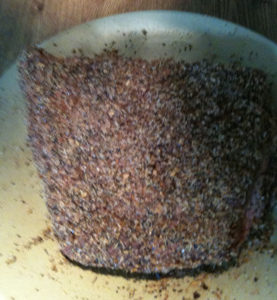 On the right over here, I have the brisket all rubbed down – you can see how thick I went with it. Do you have to go this far? No – but you do want to cover it well, because a brisket on its own is not the most flavorful thing in the world. And going a little heavy is not usually a problem because you cut it into thin strips – so a lot of seasoning on a little part helps to carry it thru.
 Now, my preferred way to cook a brisket (and a lot of other things) indoors, is using my Romertopf clay cooker. It is over there on the left – and like the name implies, is a clay cooker that treats anything inside it really nicely. But Zach doesn’t have one at Auburn, so I decided I would do this is a simple metal roasting pan.
 If you are unlucky enough to NOT have a clay cooker yet (eediots!), all you need is a pan big enough to hold it, and some tinfoil to wrap it up tight. Make a good seal around the edges – you are essentially creating a covered dish.
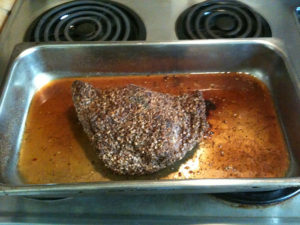 OK – after all that time, I take off the tinfoil, and I have what is actually a pretty dry piece of meat, and some lovely au jus.
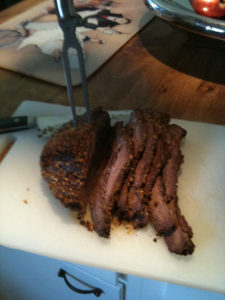 The last thing (before devouring it) is slicing it – go across the grain, and cut it into thin strips. If there is any fat left from the thick strip after cooking, it will be a thin, seasoned layer – and it is truly wondrous.


