by Marty | Jun 18, 2012 | Freelance SEO Copywriting Tips
If you are a freelance SEO writer or other type of freelancing professional, you are probably going to have to create a statement of work at some point along the way. So this post is going to look at these things a little bit: what statements of work are, why they are important, and how to create one.
Why On Earth Do You Need a Statement of Work?
A statement of work is like a contract. It is a written agreement between two parties regarding a project or deliverable – something along those lines. It is a document stating that one party agrees to perform services for another and it typically defines some of the parameters of the project and its scope. Importantly, it also often contains things that are NOT involved in the project.
You need a statement of work sometimes because it clearly states what you and the client are mutually agreeing to – what the project definitions are. By having a single outline document to which you both agree, it reduces the potential of scope creep, missed deliverables, or other potential misunderstandings along the way. You might look at them like a contract – but they are typically lacking some of the starch and legalese that contracts imply. Plus, they’re probably not as binding…I can’t say to that, as I have never had to take either through a court battle. But it seems that the omission of the legally binding terms found in contracts makes it less enforceable.
But you’ll often need a statement of work if you don’t have a contract, or you don’t have relationship with the client (you don’t know if they will flake on you or not) or you feel the need to protect yourself as a project begins – you want to define your understanding of it, clearly, and define the responsibilities of all involved parties.
So if you freelance with any regularity, it is a good idea to get one together whenever you need it – and then keep it around as a template for any more that may come along. Less and less of my own clients ask for this kind of document to get something going these days, but knowing how they work and how to use them allows me to be attractive to those clients who are more used to this approach – like agencies, and larger corporate clients. Some folks ask for it in an initial consultation, so I can answer: “Sure – let me get that right over to you.”
What Should a Statement of Work Template Include?
I am sure there are some formal guidelines to these documents out there somewhere, but I go with what works. So apologies if this is not the “correct” way – it has been correct enough for me. It likely varies a bit, depending on the nature of the project you are covering.
Typically, I would section it off, so you can include a brief look at all relevant aspects of the agreement. This generally includes an overview, a list of deliverables, a list of any tonal/branding considerations, a list of technical considerations – e.g. how each deliverable will be sent, a timeline or calendar of scheduled events, a list of other considerations or details, a list of projected delivery dates and payment milestones, and finally, a list of things defined as being “out of scope” for the effort.
- Overview/Executive Summary: A generalized look at the intentions of the effort – such as “to build content bringing more visits to this site because of XYZ.” Usually about one to two paragraphs, explaining the overall effort – used to indicate a full understanding of scope.
- Deliverables: This is the heart of this document really, which are the items you’ll be creating to answer to the needs outlined in the overview. Bullet out each deliverable, stating what it is and why it plays a part in the overall strategy.
- Tonal Considerations: You want to spec out details of the tone that you identify as important to the voice of the project. This may be from info the client sends, research you perform independently or most often a mix of both.
- Technical Considerations: These are details about the deliverable files – any specs on the way they need to be delivered. If you are writing, identifying in it is a word document or a coded html snippet would be something you clarify here. Again, this is a point where you clarify that you and the client are talking about the same thing, and share the same expectations.
- Timeline: a calendar-related schedule for deliverables – this avoids issues later, and gives a nice foundation for everyone to rely on and trust. It also alerts all teams involved of expected due dates – this is crucial to better coordinate larger efforts.
- Other: It is important for a workable template to have an “other” category as a catch-all for the details a project might carry with it. Each project is certainly unique, so in this section, you can add the oddball details and let them be what they are. You might add what the client’s expected role is, or anything required here to keep the project on schedule. A brief mention of dependencies can help to illustrate the need for ongoing communication throughout the project.
- Out of Scope: This is a crucial part of the document, allowing you to define things that you will NOT be doing during this effort. Not so necessary on smaller things, it can certainly save your ass in bigger projects. I do like to address this – it is also a place to feed ideas to the client about future work…you mention cool ideas that you will not be doing here, but make sense.
- Budget: I always like to ensure my budget for the details will be clearly written as a shared reference point -again, it helps to avoid confusion. Talk about exactly what their money is going to cover – and specify how you’ll calculate any overage (be it hourly, flat rate, etc.).
- Signatures: The whole point of this document, is two parties agreeing on something – so you need both to sign-off on it. A signature page does not always require a physical signature (entering: sig on file and having the info elsewhere works) but it give you a place to stop the project – make sure you are both agreeing to its terms and conditions (signing off on the shared understanding of each here). Have offline contact info listed in the document, so you can correct anything that hinders the signing and enactment of it.
So that’s it really: just start with a good template that points out milestones and understood specifics in direction and production, and fill in the blanks. It does not have to be too overly formal – but I do find a cross between formal writing and casual tends to hit it well for most things on these docs. When in doubt, lean toward the more formal approach than a casual one: it is always better to spell it out, clearly and deliberately. I also find that the section on “Out of Scope” items is essential to a lot of projects – stating clearly what you are not doing can be a great way to avoid issues. Let’s say you are assigned half of a marketing effort, for example, you’d want to define the items in the other half as being NOT your responsibility, even though they are required for the project to be successful…it shows you and the client agree that these are not your tasks.
Finding Statement of Work Templates
OK – you probably got a good handle on what they are, so now where can you find them? You might start here:
But really, if you uniquely brand a Word document (use a logo in the header and add footer contact information) you could literally copy the bullets above, and simply make them work for your project(s).
In case you are still struggling to see what I mean, I created a little template here from an old one I did back in 2001…Free Statement of Work Template. If you use this one, at a minimum replace all the CN references with your business name, and use it to create something specific to your efforts. Be careful to look it over really well, so any information in it is specific to you and not a holdover from this template.
A semi-formal statement of work shows you are considering the deeper details of an effort and are a professional, so even if they are not requested, most people are not going to mind if you want one used. They do serve as protection against misunderstandings that can get tense and costly for either side or both.
Use Them as You Need Them
The idea behind creating more paperwork here is, by having a single point of reference in a SOW document (as they are often called), you can stay focused on the project and avoid issues for both you and the client. You can deflect scope creep. You can stay on budget, or know when it is OK to bill more and how much to charge (a good detail to add under the “Budget” section – “This project is budgeted for $X for [deliverables]; with any extra time being factored in at a discounted rate of $X/hr/day, etc.”). You know what they want their deliverables to be, in what format using the proper tone and on which calendar dates.
In a nutshell, it protects you both to honor the project by spelling it all out, and allowing you to sign-off on agreeing to it.
I personally, have not had to use them in a looooong time (most of my clients have been here with me for years) – but a conversation with a friend recently and a close shave on a project brought them to mind, so I thought I would share my experiences with them anyway.
One time, I had a fine SOW in place (as well as a contract), but the client jumped mid-stream anyway…and the amount was too small for me to justify pursuing in small claims (where I am sure I would’ve won)…I simply let it go. Not so sure I would let it go today, but I know more now, and am a bit more protective of my time than I have been in the past. Luckily, as I said, I hardly ever bust one of these out any longer – most of my work is arranged in an email or Skype call with people I trust a lot.
If you are trying to sort these out, and found this post but need more help – just shoot me an email or comment below, and I will do what I can to help you sort it out.
It may be a hassle-ly bit of paperwork, but ultimately, it can save you from heartache and can keep your work life much easier to deal with. It is definitely a document you need to be familiar with and comfortable producing quickly as needed – some clients do ask for them, so you want to take it in stride, and say “Sure: let me tweak one out, and I’ll have it to you this afternoon.”
If you have a decent template that has worked for you, you will find it only takes an hour or so to make sure something like this is complete and accurate to the new effort, with all the new client details (be sure to edit it well!). The difference in having it later on can be illustrated in something simple, like a date or tone expectation to be reiterated or re-established in some way – but many times, it is used as the basis to argue why you won’t do something – because it is clearly out of scope from the stated plans. A project likes to bubble all over the place sometimes, so this is one document that helps to protect both parties involved from the effort spinning out of control.
by Marty | May 29, 2012 | Reviews of Stuff
I have an old friend, a guy I worked with in the scooter shop years ago, who went on to become a very accomplished luthier when the Vespa restorations weren’t cutting it any longer. A luthier is a guy who makes guitars, and I remember not being too overly supportive of Kris’ interest when he asked me, way back as it was sparking in him – because I was jaded, knowing in my past more than a couple of amazing luthiers who were broke and bitter.
Luckily, Kris paid no attention to me or my cynical kerfluffles, and went on to became quite an artisan, crafting some truly beautiful instruments – which you can learn more about on his website.
Backstory aside, Kris sent me an email about a thing he is doing with some friends of his, so I wanted to post it here – he wrote:
We have recently organized a unique instrument donation program called The Gift of Music Project and we need your help!
We are currently in the fundraising phase of the project and are in need of pledges from you to make the program a success. The goal of the project is to create and provide instruments to deserving music programs and young musicians.
We have a series of one-of-a-kind “thank you” gifts at various donation levels that will be sent directly to you as a token of our gratitude. Every donation counts so please just pledge the amount that is right for you.
If you have any questions, comments, or suggestions about the project please feel free to contact us directly through the campaign site.
If you are unable to make a donation at this time you can still be involved in the project by sharing the news of this campaign through Facebook, Twitter, Tumblr, etc.
Thank you so much for your help and generosity!
For more information about the project please visit our campaign site:
http://www.indiegogo.com/projects/77688?a=492488
Warmest regards,
Kris Barnett and fellow Gift of Music Members
www.krisbarnettguitars.com
As a guy who benefited from having instruments around to play with, I am all about supporting things like this, to put awesome instruments in the hands of those who want them…so do what you can to help Kris Barnett, and his music project.
by Marty | Apr 6, 2012 | General Pearls of Wisdom
 Hopefully, you have never heard of Stephen Pierce. And unless you either frequent internet marketing dens of inequity or have accidentally answered the phone, chances are good you haven’t (we hope). But there are a lot of people that have heard of him, and as a result, many of them end up with a lot less money and no good explanation for it. I will let my friend the Salty Droid tell you all about it in his recent posts: Vorys, Sater, Seymour and Pease LLP, and Stephen Pierce…standard warning about the filthy language over there, and I do encourage you to do enough reading and link following to understand the specifics.
According to Salty’s investigating, Pierce not only has scammed tens-to-hundreds-of-thousands from people buying biz-ops, but he also flexes his lawyer on them, and sues people all the time. It doesn’t take a genius to do a little web searching and find tons of complaints on Pierce – but these are common in the stinking, scuzzy world of biz-op Internet marketing. What is not common is to sue people as much as Pierce does, and this is pretty unappealing by most standards. It’s like stealing the wheels off wheelchairs, or raping the wounded.
Here’s the interesting thing though. There is a legal action brewing against Pierce and his company, led by an attorney in Dallas named Allen Rosenberg. The way a suit like this works though, is the attorney for the plaintiffs cannot solicit more folks to join in – so the word has to be spread in other ways. Like on Salty’s site, or this blog post.
To quote the droid from the most recent post, The People VS Stephen Pierce:
Dallas Attorney Alan Rosenberg is preparing to bring a lawsuit against Stephen Pierce International {and affiliated companies and individuals} for the victims of SPI’s various scams :: fake opportunities :: and boiler room soul crushings. Alan and his firm :: Chamblee, Ryan, Kershaw & Anderson, P.C. :: have agreed to take the case on a contingency basis … which is super awesome of them because people who’ve just been scammed for insane monies don’t tend to have lots of cash lying around.
If you’ve been scammed by Stephen Pierce {or a phone room calling in his name} you should consider being a part of this suit. Not just for yourself :: or for the money {which you deserve to get back} … but because it needs to be done for the greater fucking good. Because it’s not going to stop unless we all step up and do our part to stop it.
Contact Alan Rosenberg at this email address for more details about getting involved in the suit.
All of the links there are live, and I do encourage you to reach out to Rosenberg if Pierce’s organization (Stephen Pierce International) had or has you in its tendrils. And, if you have a blog, or Tweet, or Facebook all the time or something, make sure to help spread the word, so victims can learn about this action and come forward, and hopefully get back some of what they lost here.
Here’s hoping this suit gets huge, and brings more light to this subject matter – not to mention a little well-earned restitution!
by Marty | Mar 3, 2012 | Freelance SEO Copywriting Tips

Editors? EDITORS? We don' need to show you no steenkin' editors!!
So I was surfing around for images on a couple editing gigs I have going, and out “there” saw couple examples of why it makes sense to never use an editor. That I just watched Treasure of the Sierra Madre again is beside the point. The following examples clearly illustrate why you don’ need no steenkin’ editors.
Example A: A Clutrual Experience

The image here was on a photographer’s bio-links on a well known photo site. The thing that impressed me on this, was just how many rules of English are abandoned in so small a space. Time is money after all! You can clearly see how an editor here would have simply screwed things up, and distorted the clarity of the message. Better that this artist handle it alone. You go girl!
THANKS FOR BUY! MORE CHOICE IN MY COLLECTION: is a really great way to lead off. It immediately expresses gratitude for buy which hadn’t even occurred yet, so this was right on the money. Buy is the heart and soul of all e-commerce, and it it is made perfectly clear that there are thanks involved.
Following this strangely effective expression of gratitude, the user knows they can also have more choice in collection. Hemingway would be proud – the copy here is so terse it does not even waste time with plurals or clarity. Well played, ma’am, well played. You had me at “thanks for buy.”
All of this is really just leading users naturally and effortlessly into the glorious cluture on display. Then and only then, all becomes clear. Having more choice in a cluture collection for buy brings us all one step closer to conversion, and this artist knows it. She feed us with good, long time.
She was not one who was going to waste valuable resources on an editor for something going out as her portfolio, because this was of course note-perfect as it is. The potential clients are ready for buy more choice in collection, so get those cash registers ready, honey: there’s a cluture stampede coming! No steenkin’ editors needed here, gringa!
Example B: The Chef’s Dick

This next example shows us that it is difficult to run a restaurant and the potential disasters that occur when you don’t maintain strict standards in uniforms.
The chef was evidently having difficulty with his trousers, but how the staff was involved, we don’t really know for sure. We might assume that they had to take turns holding the pants closed for the chef who was obviously busy cooking and couldn’t do it himself. Maybe it was a problem due to an unusual shape he had, or a slope in the kitchen floor where he worked.
I like the idea that the owners are genuinely concerned about the chef’s uniform and working environment, and are doing all they can to protect his dick. I want to eat here!
What really gets me about this one though, is the cryptic way the omission of the last verb pushes it back on us. “We can’t ____ any staff to stay,” can be answered in so many ways – I am glad they understood to leave that up to the reader to figure out…as if we didn’t have enough on our hands with the chef’s dick falling out all over the place! An editor would have suggested making this more rigid, so the restaurateur is correct in expressing it more openly and pulling the reader in.
I came up with a couple options, kind of like Mad-Libs to help figure out what might be going on in this restaurant.
We can’t — any staff to stay:
- afford – they spent all their money on new pants and faulty zippers for the chef
- force – they are afraid the chef’s dick may interfere with proper dinner service
- train – the waitstaff has developed a sense of wanderlust (inspired no doubt, by the chef’s dick)
- hypnotize – hypnotists are expensive
- find – the staff are all hiding from the chef’s dick
- trick – everyone knows that restaurateurs routinely trick waitstaff with shiny things
I know if it were me coming to the restaurant’s window and seeing this, I would hope they could work out whatever problems the chef’s dick keeps causing. Maybe they could buy him some special equipment, or a custom made harness. Maybe some duct tape or paste or a helmet would help.
Just seems like his dick inspires and unlocks so much mystery, it would be worth trying a few more things before you just give up and apologize, locking the door. But wait.
Through this sign’s editor-less artistry, we leave (hungry) and are intrigued by the chef’s problems, and made all the more curious by connecting ethereally with the staff. I may leave now, but I am coming back later to find out more about the chef’s pants, experience more connections with the staff and maybe get some lasagna. Very sneaky, and shrewd – and only possible without an editor in there, hell-bent on ruining everything.
by Marty | Feb 24, 2012 | Stuff for Foodies

OK, the Holidays have officially passed. I dragged the old tree down into the woods a few weeks ago, and put all the decorations back into storage. Now that the parties are all said and done and us merry revelers are forced back into our sterile routines, it is finally safe for me to bestow upon you the best egg nog recipe, ever.
I would not do it during the holidays to ensure my own gatherings were memorable – indeed, people have come to understand my egg nog is not like others, and is worth enduring my prattling on. Every time I make it, people ask for the recipe, or an IV – usually both. They pledge to listen to me, if only long enough to latch onto the ‘nog tit. I get it.
I decided after so many requests again this year, to finally give the recipe away. If you like egg nog, this recipe is going to make you cry with unbridled joy, or pray, or orgasm, or do whatever you do when mouth awesomeness overtakes you. It is boozeless, but go ahead and spike yours as you see fit. Captain Morgan’s Spiced Rum or brandy are both good I hear.
I give a solid nod to my Mom – it was her recipe I read, and stole/appropriated to create this one. My Mom’s egg nog in the 70s was crazy perfect, and a granite memory of mine. She would fill milk jugs, and we kept them in the snowbanks outside the back door. I dialed back a little of the sugar and some of the control and precise measures hers had, but otherwise, this is all Mom’s recipe. Definitely came from me trying to recreate that unmatched deliciousness.
———————————————————————–
Ingredients for The Best Homemade Egg Nog Ever:
- One dozen eggs (yep – all of ’em)
- One half-gallon to a gallon of milk (skim, 2%, or whatever)
- I pint heavy whipping cream
- sugar- white refined or powdered – 1 half cup, and one quarter cup, separated.
- a good shot of vanilla extract, 2-3 times (eyeball it, but don’t go crazy)
———————————————-
 Step One:
separate egg whites and yolks. Put yolks aside.
Sounds so easy – almost care-free and fun. Separating eggs is pretty hateful though, at least to me – this is by far the hardest part of making this, but absolutely required.
Suck it up.
Step Two:
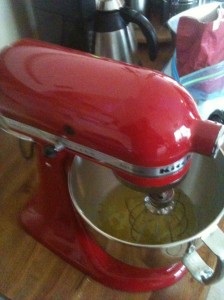
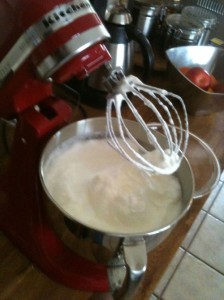
add quarter cup sugar and small shot of vanilla (optional) to egg whites – beat until they are stiff peaks – a meringue is what we want here. Set meringue aside.
(Note: I have used Cream of Tartar in this before to help stiffen the meringue, but did not see a change really when I didn’t have it, so I don’t normally use it. Go ahead if you have some – because how many times do you ever get to use it? Cream of Tartar soup?)
Step Three:
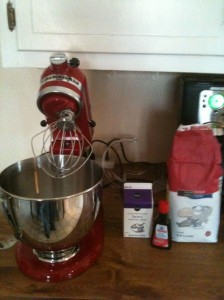
mix together the heavy whipping cream, a good solid shot of vanilla extract, and a half cup of sugar. When it’s creamy and smooth, stop…especially before it becomes too thick and turns buttery. You are looking for whipped cream that is very soft and silky.
Step Four:
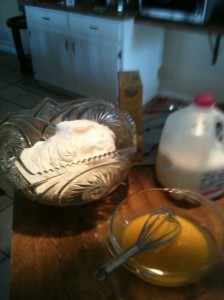
In a separate mixing bowl, hand-whisk egg yolks with a medium-to-smaller shot of vanilla extract. Slowly add milk (the full gallon or half does not need to be used – you can use less, and the nog is richer…but about half should be fine and the rest is to taste). Whisk milk with yolks for consistency…looking for simply a nice blending of all ingredients. Light froth is OK, but settle down.
Step Five:
Combine the meringue and the heavy cream in the serving punch bowl, then fold-in the yolk and milk mixture, stirring constantly. Pull the meringue and cream into the yolk-milk mixture, blending all. Even after generously mixing, it will settle and produce a very light/whipped froth on top, and the nog will be below.
Garnish the frothy top of this drink with ground nutmeg and cinnamon…I tend to be a little generous. Better if you can shave nutmeg onto it, but hey.
———————————————
It seems like this would be super rich with all those ingredients, but it is really light and airy. The meringue is the key – it really makes this stuff have an amazing texture.
I have made this with hand mixers, and now a couple times with a KitchenAid big mixer (my Precious is lovingly in those images above) – and there is no comparison to how long it takes – the KitchenAid is so key in the process, I am even willing to make it more often now.
So there you go – I imagine less people may be coming by this Holiday season if they see the recipe posted here…thank God no one reads this. But if they all stay at home, inducing their own egg nog comas – I totally understand. 🙂