by Marty | Feb 4, 2012 | Freelance SEO Copywriting Tips
If you think this post is going to be filled with clumsy, juvenile double entendres, I hope I do not disappoint. But if you are squeamish at that thought, this post is really about editing text. Dirty, filthy, slutty text.
It’s the Story, of a Lovely Project…
In my daily travels, I often connect people to writers. If someone comes to me looking for writing help, I am not always able to jump in there myself, much as I’d like to. But I do know lots of writers, so I can often connect the dots. Such was the case recently, when a good client came to me seeking some content on getting paid to take surveys online.
I was booked solid (yay!), but had a good fit (I believed) so I connected the client and the writer. I actually worked as the go-between here, telling the writer what the client wanted in this site’s copy, and working with them both. I even wrote the home page to get things started.
The writer I connected here does fine work – she’s a very smart lady from the deep South who always hits the mark. She got the brief specs from me, and wrote her 5 pages. I gave her drafts to the client, and he coded them and posted them. Because I sent the client her unedited drafts, I also offered to edit these pages if the client wanted me to do so…I paid the writer, and cut her loose after she drafted the basic content for us.
Coining the Term: Big Sausages of Text!

 The client thought her copy was well conceived – but the way he received it was not exactly what he wanted. He referred to her pages as having “great big sausages of text.” I thought that description was pretty funny, but when I went to the site, I definitely saw what he meant.
You can see it pretty easily…these are swollen fat things for sure.
Again, there was no issue here with the content itself, but these sausages of text needed squeezing.
Some clients use me time and again simply because they know I am an expert at squeezing the sausage.
So it was on.
Handling Your Sausage
The best way to handle your big ol’ sausage, is firmly. The time to be gentle is over once it is fully drafted – it is then time to really wank it and make it work harder for you. Slap it around a little. My writer would have done this herself if we had asked, but we had already sent her on her merry way…off to make other clients happy.
Fixing a piece of sausage text takes all kinds of forms. Sometimes, you need to just rub it a little bit, putting-in or taking-away some simple stuff to make it work better. Sometimes you need to get more drastic in the presentation to achieve something that works as well visually as it does cerebrally.
Because the client here liked the copy but not the general sausageness of it, I knew I simply needed to squeeze this a little to bring it off.
The first thing I did, was read it thru and edit it a bit. I made sure the ideas were fluid, moving logically down the pages, supported when appropriate…which they were. Made sure there were no errors or grammatical gaffes, but again – the client was fine with the writing, the writer was experienced and solid, so I just made sure more than actually changing anything.
Space – the Final Frontier
The next thing I did, and one of the most important steps here, was to insert some space. Web readers don’t like to see a big sausage of text – they can get intimidated, and often leave without touching it. We can’t have that.
So I look for logical places where I can bust-up the blocks: I find where I can really squeeze that sausage. Like most articles, these had lots of spots where I could put in a line break and not ruin it.
Web readers are good (generally) with about 2-3 lines at a time, so this is often my loose target. I give audiences credit for having no attention span whatsoever, and work from there. However, this is a text-driven and very text heavy site so I knew the paragraphs were going to be longer naturally (unless I edited much more deeply). Given that the goal was not to re-edit everything here, I stayed with what was on the page…but I also knew that size matters.
I also searched for places in the writing where I could use bullets or a blockquote, knowing these are other easy ways to create space. Again, most often you will find any well-constructed article will suggest some of these callouts to you – they feel very natural.That was what I found here, too – a few natural places to utilize this tactic.
So in a very short time period really, I was taking advantage of many simple ways to make my content work harder.
Getting Headers
With the text broken-up more on each page and some bullets, I looked for places where the ideas changed a little bit and added-in some headers. Normally, I create headers as I am writing – but as this was a editing gig, I was seeking kind of “obvious” places where I could accent shifts in textual or conceptual nuances with a simple header.
Headers allow a reader to scan a page quickly and see what it’s about – making them another simple way to work the content harder. Additionally, headers are a fine place for a little SEO, so with minimal effort you can make them contextually relevant as well as strategically crafted.
I should comment too, that this is one area where new writers tend to need work – in the ability to create headers that tell the story, entice the reader to read, and answer SEO needs all at the same time. It does seem easier than it is, but it is an area where many new writers can actually step up their game, in terms of how their work will be received.
In this particular case, I was not overly concerned with the SEO but it is certainly never too far from my mind when working on a website. I was more about the visual here – I had this sausage now well in hand, and was eager to finish-off. I was about done spanking and squeezing it, so getting my headers in there brought this off beautifully.
The Finished Page
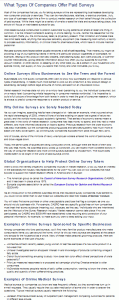
 That was really about all I did to squeeze the sausage from these five pages – but the difference in them is pretty clear to see, even at a distance.
The client liked the changes, and posted them.
The difference in her text and mine is only space, bullets and the headers – otherwise, they read almost exactly as she submitted them.
Since the site is new, there is really no analytic data we can compare, to see what effect this has, if any. If I were to do this on an existing site, I would look at the time spent on the page before and after you squeeze the sausage. It should increase, you would hope. You also might look at paths into and out of the content, and bounce rates – the measures of engagement.
Now that wasn’t as bad as you imagined, was it? 😉
by Marty | Nov 27, 2011 | Stuff for Foodies
 This year, I decided I wanted a little more of a traditional turkey kind of Thanksgiving meal. You see, I have been creating meals for this lovely holiday for years and often try to throw a few curve balls in there, just to keep it lively. I might make duck, or ham, or ostrich or something other than turkey – but sometimes, a good old fashioned treatment is all that is needed…or wanted.
And there was at least one thing I had never done to a turkey before that I kept seeing mentioned, and that was brining it. Brine was an alien thing to me until I read up on it a little, and then it made perfect sense – so I made my family the guinea pigs this year as I brined my first bird.
What is Brine?
Brine is a solution where there is a lot of salt. Kind of like salt water/stock on steroids. The salt-to-stock content is over 50 parts per thousand, so this is a thickly salty solution.
Why Make Brine?
They used to used brine to preserve food, but we have better ways to do that today. Brine is used today primarily to enhance flavors and cooking or pickling techniques. Making your own gives you control over flavors more than anything else, in my opinion. If you make it, you can depend on how it behaves (or should). And the magic words: it is easy.
For me, I wanted a way to keep my bird moist through cooking for a long time in the oven, while infusing a little flavor. The things I read about brining made me think it was a smarter way to prep a large bird. I have basted many of them in the past with great success – they truly look like champs, but the meat is often very dry. I saw brine as a way to get deeper to the meat in preparation for a long day spent in the oven.
My Approach to Brining the Turkey
Once I decided on brine, I had to learn how to do it. Essentially, you make a saltwater boil – dissolving a lot of salt into the fluid. I am sure there are measurements somewhere, but I eyeballed it, and just dumped most of a new shaker full of Kosher salt into a pot of boiling stock – (I used beef, vegetable and chicken stock…mostly vegetable). A shaker here means something similar to a shaker of Parmesan cheese size…about a cup an a half to every gallon of stock. Just remember this brine needs to be more than 50 parts salt per every thousand.
The salt is what permeates the skin and opens up the flavor options. So I added a bunch of stuff to my brine to kick it up, like a quartered apple, a bunch of allspice berries and some star of anise, some cayenne pepper, honey, brown sugar, black and pink peppercorns, and other “darker” flavors. Chucked in a half bottle of Napa Valley red, just to be fair. I was going for a specific taste, so built on the allspice swirl with cinnamon sticks and coarsely ground nutmeg. I knew most of this nuance is lost in the process, but figured what the hell. 🙂
I brought the brine to a boil, then simmered it for about a half hour to mix it all and blend really well. I kept adding stuff too – like a kid and his chemistry set. It smelled like a warm winter’s drink. I cursed my lack of ginger root…but it still came together. Looked like spiced soup.
I killed the heat and brought it down to room temp. Once at room temp, I put the whole pot in the freezer for a little while, to create a chill for it.
When it was chilled, it was done.
The Ice Bath
One point of brining that I learned was you need to do it very cold to avoid bacteria. This is why I needed to put the brine in the freezer to chill it, and this is why I needed to complete the process with an ice bath.
I took my thawed turkey, removed the neck and giblets, rinsed and dried it, and put it in a new Tupperware 10 gallon storage thing I bought at the store. I poured on my chilled brine. I then took all of the ice from the freezer, and added about 2-3 gallons of water, to make the turkey float. I said goodnight, set an alarm for 5 hours and left it in the garage overnight like this.

Ice cubes all over my 18 pound turkey
The ice bath was a key to letting me simply drop it and go, too. I liked the idea that the meat would be fine, that bugs and bacteria were both repulsed by the cold and that it stayed easy.
I did have to buy a new Tupperware thingy to hold this, but that was a small price to pay for the technique being clean and simple.
You can’t tell by the picture, but the turkey was floating here – just enough fluid to keep it off the sides and bottom. The ratio of water to brine was about 70/30 in favor of the brine. I did have more salt, just in case – but I figured the kosher stuff I added to the brine would be fine.
I flipped this bird in its icy brine bath about halfway through – 5 hours in. I added a little more ice, and some salt…just handfuls of each.
After I woke-up on turkey day, I went down, removed it from the brine, patted it dry, and put it in the refrigerator. It had been there about 12-13 hours – it was an 18-pound bird.
Keys for Cooking a Turkey: First, Don’t Stuff It
I learned that stuffing a turkey slows down the cooking time as well as introducing the potential for salmonella. So instead of looking at the turkey’s empty cavity as a dutch oven to cram full of stuff (which I usually did), I used it for the space in creating aromatic/taste infusions. I cut a bunch of fresh herbs from my garden (sage, rosemary, thyme, tarragon, etc.) and layered them with sliced apples and oranges, leaving most of it open (it was a big bird). A little more than halfway with the layers.

Sliced apples, oranges, and fresh herbs
Next, Don’t Prolong It
The other thing that I now see as a mistake I made for years, was to cook the turkey too long. By extending the time in the oven, the potential to dry out the meat increases greatly. So my older way of doing this, might be to put the turkey in there on a relatively low heat (350-375F), opening the oven every 30 minutes to baste. But what I did not realize, was this constant opening the door, and the loss of heat simply made everything take longer.
To fix this, and still get a nice crispy skin, I again kept it simple. I rubbed it down with some extra virgin olive oil. I made a little tinfoil cover for the breasts, knowing they would need it to keep from burning – and I set it aside (easier when the turkey is still cold). I set the oven for 500F and once it hit temp, I popped it in.
After 30 minutes, I dropped the heat to 350F (my oven cooks hot), put the tinfoil on it, and let it go. It still took me about 41/2 hours to cook it off from there – but that was considerably less time than it would take for a bird this size, if I did not start out really hot like that, I believe. No basting either – I allowed the heat and the olive oil to take care of that for me.

Yep - it was as good as it looks. 🙂
So I was pretty pleased with this – I waited for the little pop-up thing to go up, and I checked internal temps to make sure it was at least 160F. I let it rest and made a traditional gravy – in the roasting pan, using a simple butter and flour roux. When I carved it up, I had the pleasure of finding it to be moist and perfectly cooked throughout -the brine left subtle flavors, but was more of a way to keep the texture and consistency stable while the bird cooked.
There were only six of us there to eat on the thing, so it is now 3 days later, and I am still eating it for every meal. We killed the white meat today – but thru it all, the brine was a champ – even on reheats, this turkey did NOT dry out at all – not even a little bit. I got my traditional bird flavors and textures, and learned more about a cool way to prep big pieces of meat.
I will be trying this with things other than turkeys – so watch out world. Listen for that dinner bell, and bring your appetites!
by Marty | Oct 19, 2011 | Finding Freelance SEO Copywriting Work, Freelance SEO Copywriting Tips
 I am up to my nipples in work right now – mid-stride in the busiest month I can remember for a long time. It’s very exciting for me – I have lots of really interesting projects, none of them even remotely related to each other. I am working on sites all over the world, with some really fantastic people. Articulayers itself has more writers in-house this month than ever before – we’re in the middle of the most aggressive content strategies I have ever been a part of. And my guys are nailing it – if I don’t say it enough, my hat’s off to you, brothers and sisters.
But this is not a means to trumpet about anything I am doing specifically or what my good friends here at Articulayers are cranking out, as much as reflect on the fact that all of this great work is not coming to me – I am going to it, and engaging. I am pursuing that which I’d like to do – though grateful that I do get many solid requests for projects from intelligent clients. But I am not waiting for them to come to me – I go after what I want to do, and starting consciously working toward it.
Work begets work.
Many of my writers on board now are just starting out. This isn’t their first writing gig, but I am willing to bet that for most of them, it is the first one where they were assigned 100 pages to write. This will keep them all insanely busy – hammering away at the keyboard, turning out the prose like champs. Working on a heavy deadline, answering the client’s needs.
During these 100 page assignments, they are going to come to know things about how they work best. Do they need it quiet to get focused, or is music a good motivator? How many pages can they do in a day? How long does it take to edit and finalize the copy? All this and more will be dealt with – and they will all emerge stronger as a result.
But then, this project will end, they’ll get paid and they’ll need to get more work. Some of it might come from here, certainly, but it might not be enough for them. So they can take the lessons learned from creating 100 pages, and roll it over into a pitch for doing something similar for someone else. They’ll now have samples they can share of what they do and can use the work they completed as the tangible means to establish new working relationships. They can prove they got paid to write in the past and I will be right here to confirm it for them. They are experienced professionals by definition…and this is valuable.
Work begets work.
Not every one of these writers is going to like doing this work – it is inevitable. But this is not a bad thing to realize – this is actually a positive thing, too. Because writing for a living is not glamorous very often. If hammering out 100 pages, or doing a tri-fold, or writing a website is not your cup of tea, then look into other kinds of writing, or other kinds of work – but knowing what you won’t do is just as important as knowing what you will do. It is important to try though, to not make a judgement call from the cheap seats without first getting in there yourself and slugging it out for real.
The one thing (besides awesomeness) all of my writers share right now, is a willingness to jump in. They are all committed, and trying their best and that does matter, it counts. Not just to me as their boss right now, but it matters to them – because they are learning things about themselves, how they work, and getting a taste of what it means to be a writer for a living.
Work begets work.
When my awesome month is done, another will take its place. Followed by another, and even more after that. But I am not going to be standing here, looking at my reflection and murmuring Abba songs, I am going to be using the lessons learned to be creating more great big piles of work to do. I have a roster of clients that is comfortable, yet challenging. There is diversity in what I do, and I seriously love it, every single day. I have had LOTS of jobs, and know really well what I don’t want to do any more…and I am not even close to it.
I won’t have to look for anything that is not writing-marketing-internet focused. I have the benefit now of being able to create projects on my own, or I will gladly do whatever one of my clients wants me to address. I take none of it for granted, and am grateful. I want to give back, because the people who have helped me find success were so good to me, it needs to continue. The best way I know how, is to keep working, to stay plugged in, and to be here – ready and eager for the next project.
My newer writers might wonder about what it is like to write all the time, but when we talk about it next time, we will have a common frame of reference through this project, and be able to take the conversations and understanding further as a result. This is important, and meaningful. And it happens this way, because they are willing to work first, then talk about what it means – they get in there and start typing , and hand in 100 pages before we start talking about forever.
I have a great deal of respect for people willing to work. It is fine to understand that some work is not for you, but typically only when you are pursuing the work you champion, and have some experience or relative logic behind the things you shoot down. I don’t like to say no to work – and normally, only other work stands in the way of working on something.
I know my mantra well.
by Marty | Sep 22, 2011 | Finding Freelance SEO Copywriting Work
I just was asked by the good folks at Emory University to come speak to some students about freelance writing. I of course said yeah, because I really like talking to new writers, and letting them know that they can do it. The people over there at Emory have always been really nice to me, and I am happy and honored to be part of this.
This will be the third time I am talking over at Emory, but I also make some semi-regular appearances at my own Alma Mater, Kennesaw State University for the same kinds of things. I never plan what I am going to say too much, just kind of go and wing it, based on what people seem to want to know.
Generally, it seems like people want to know how to get started – and I always say the same thing: just get started. Young writers tend to romanticize this lifestyle (although it is pretty cool, I gotta admit) so it seems like it is harder than it is. I actually offer work at many of these things too – but don’t always have people following up on it, which is pretty weird to me. I know when I was a student, I would’ve killed for a chance to write almost anywhere, and my main point to aspiring writers is to keep working, even if you are not getting paid yet. If you stick to it and have talent and drive, you can make a very decent living doing all kinds of writing. I hope to illustrate that to them in a simple way.
So I hope to be entertaining and honest at least and can clearly express my love for this career path. If you are going to be attending this thing (I’ll post some details here when I have them) and want to know something specific from me, feel free to give me a yell, or comment below and I’ll certainly try to answer it for you – otherwise, I am looking forward to meeting some new folks, and get them fired-up about hurling verbs.
More info on this as I get it…
{later add}
It is called “Careers for Writers Networking Night” and will be held in the Winship Ballroom at Emory, from 7:00-8:30 P.M. it is in “the Duc” – Dobbs University Center.
I got one email on it so far, and will tell you – yes, we will be covering the basics of building a portfolio. Briefly – I think I have like 5 of my 15 minutes. Warhol would be proud. 🙂
—–
OK – it’s over now, and I didn’t spit on anyone I think, so I have that going for me. I did spill some juice at one point like a spaz – but no one was too close, so no harm…just embarrassing to spill something for no good reason.
I forgot how they run it, but it was really cool. There were tons of us writers there, covering a wide range of potential career paths. We introduced ourselves and then it was simply a big mixer – folks drifted around, talking about whatever they wanted to know with folks who could offer answers.
I talked a bunch (surprise, surprise) – but the students were great – not a silly question all night. I hope I answered some things for them – it was pretty active, and I tried to stay focused for them. I have no idea how many were there – but they were all on the right path, as far as I could see. Lots of intelligent, well-intentioned folks. Not one of them was at home, watching TV – they were all doing something to increase their experiences and understanding. From that aspect, it was a success for sure. I know I’ll see the work of some of them out there. 🙂


My thanks again to Paul Bredderman over there at Emory – he has always been a very great host, who holds quality events for his students. I hope they know how lucky they are – not every student has those kind of opportunities. But mostly thanks to the writers-to-be I talked to all night – I really appreciate you allowing me to come over, and chat with you. Always feel free to email me – I had a lot less cards when I got done, so feel free to ask me anything you want, any time. And welcome to it – writing for a living is pretty wonderful.
by Marty | Aug 31, 2011 | General Pearls of Wisdom


 The client thought her copy was well conceived – but the way he received it was not exactly what he wanted. He referred to her pages as having “great big sausages of text.” I thought that description was pretty funny, but when I went to the site, I definitely saw what he meant.
 That was really about all I did to squeeze the sausage from these five pages – but the difference in them is pretty clear to see, even at a distance.
