by Marty | Dec 18, 2010 | Freelance SEO Copywriting Tips, General Pearls of Wisdom
Ok, I’ll confess: I am writing this, simply so I can put up the fish pictures. Guilty.
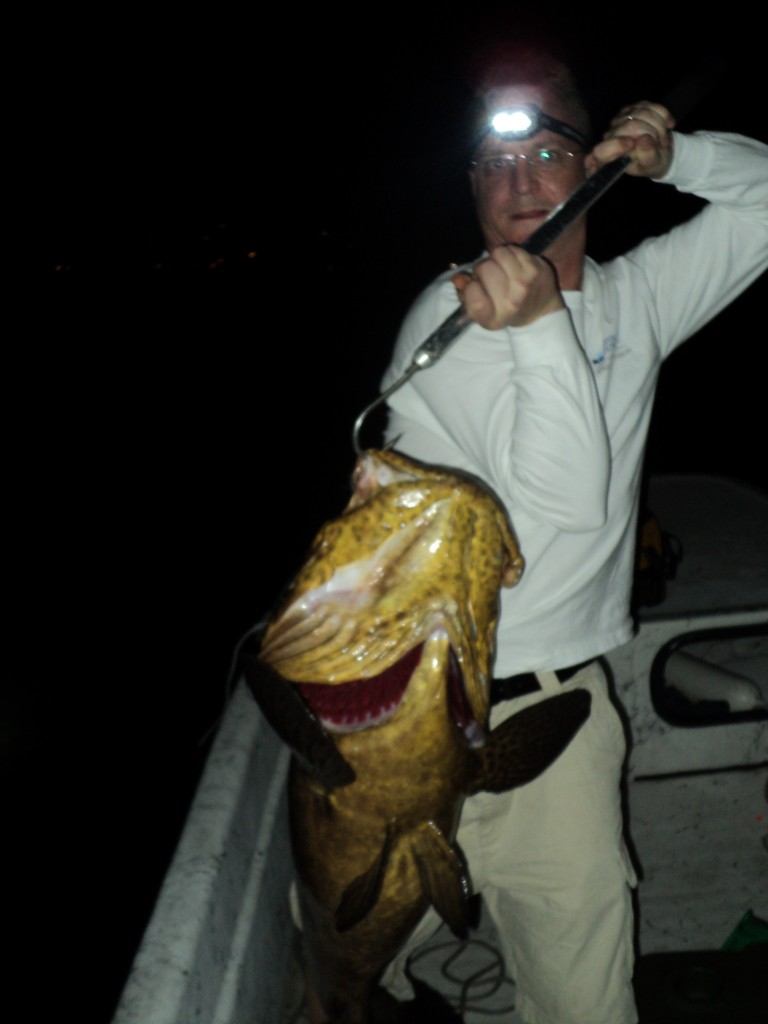 But I did come up with a decent enough running metaphor about this fishing trip. Let’s call it an online marketing plan. Just substitute it.
Work with me, here. 🙂
Step One: Find a Seasoned Guide
The first thing about catching a fish like this, is to have a seasoned guide know where they are, and how to catch them. There are million fish out there, and lots of ways to catch different types.
This guy is a wonderfully healthy Goliath Grouper or “Jewfish” if you are working blue. (They are catch and release too, so I let him go soon after this picture, in case you’re worried.)
But I wanted to catch big fish, so I connected with my friend Darin. Darin fishes around Sanibel Island and the waters off Ft. Myers all the time, so he knows where to find fish, and how to catch them. He is an experienced guide, someone I can trust.
We were targeting big grouper – so this picture shows Darin is a good friend to know when seeking this kind of thing.
You can catch plenty of different kinds of fish with or without help, but if you want the really big ones on purpose, you usually need help from someone who does it regularly.
Step Two: Use the Right Bait, Even When It Is Unconventional
I am going to give away a secret bait: Ballyhoo. These little cigar-like fish are th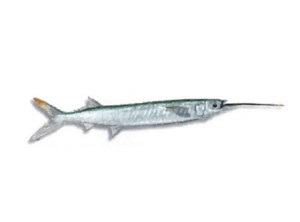 e best bait I have fished with, I think. Everything hits them, in the same way that everything hits a shrimp-however, the types of fish, and potential for big ones is infinitely better with Ballyhoo, in my experience. Could be where we are fishing. But I have caught so many different species using them, I am convinced they are a great hidden secret.
Darin told me, he started using them because he was finding them consistently in the stomachs of big fish he cleaned. Most guides and captains will use baitfish like shiners and pinfish, but Ballyhoo are unique. Why? Because they are not the easiest baits to find and catch.
Darin came up with a unique system, where he stands on the front of the boat with a dip net he made (“All the store-bought ones kept breaking,” he explained). I shine the light on the water’s surface, and he scoops the baits. We do it slowly like this, by hand, and it can take a long time sometimes depending on the conditions.
Sometimes, we chase the bait around trying to find them. Sometimes, they seem to be everywhere. And different fish mean different baits. If we were going after Tarpon (more on this later), we’d have been catching Ladyfish. Ladyfish are munched by really big Tarpons, so it makes sense. Ballyhoo are munched by Grouper – so we went after them with the dip net. It was painstaking – but with purpose.
The key to successful saltwater fishing, is to know what the fish you want to catch will eat. Using that as bait only makes sense, even when you need to figure out a unique way to capture the baits that work.
Step Three: Fish In the Right Place
Not to be coy, but the Gulf of Mexico is a big body of water. Knowing where to fish in it to actually catch something on purpose takes a long time, and lots of effort (see qualified guide, above). However, with the help of a qualified guide, finding fish is not so difficult. And once you know where the bigger ones are, you can become selective in which ones you go after.
A guy like Darin knows where structure is under the waves, and other common water markers both above and below the water’s surface. He also knows how the tides move, how fish behave, and even the general layout of what look to me like repetitive, nondescript clumpings of mangrove trees.
Darin takes us to the right place, quickly, and with purpose. We don’t mess around when we go out – usually on the bait within 30 minutes of hitting the water, and fishing about 30 minutes after collecting them.
But once we have bait, we don’t throw it indiscriminately wherever we end up, and hope a big fish happens by. Sure it could happen, and sometimes does – but there are better ways to target when you allow experience to guide it.
We were after big Grouper here, so we went to a place where they hung out, armed with plenty of delicious Ballyhoo. We increased our odds exponentially – based purely on Darin’s experience in the area, and my willingness to trust it.
Step Four: Be Patient, Persistent and Determined
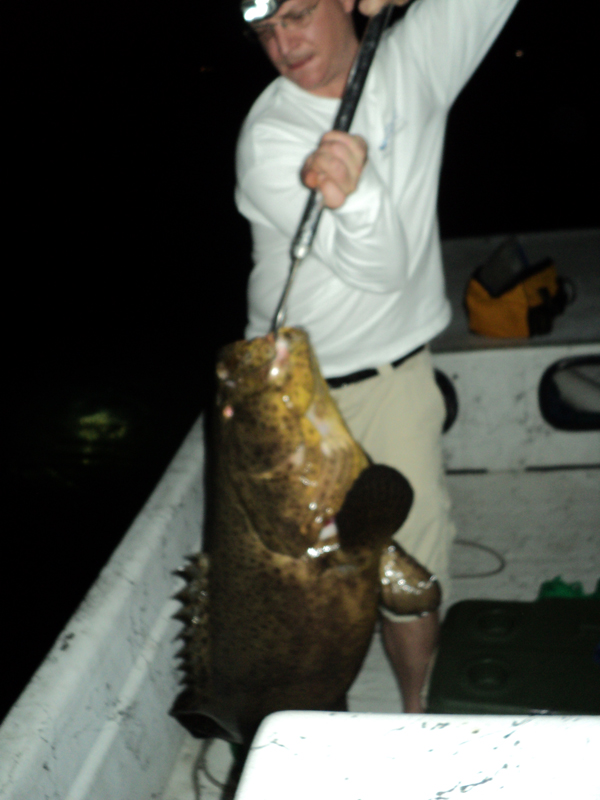
Landing this guy took a long time. He hit, and then ran and wrapped under a bridge piling (they are smart like that). I fought him for a long time, and then was convinced he was not coming up. I never let go, though – I never let slack get 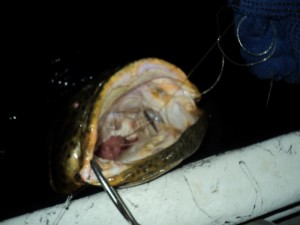 in the line, so he could flip off.
I handed the pole to Darin, to see if he could pull him out from the snag. He did, and we landed him a little while later. The old guy was tired, and reeling him up became pretty easy, once we moved him back into open water.
When we pulled him up, Darin stopped, and got out a pliers. He found a couple leaders and hooks tangled-up in this guy’s mouth – so Darin cut and pulled it all out of his way, to make it easier for him to swim, and to breathe.
We laughed at how many times the old codger had bested attempts to catch him…we saw the proof. He was a grizzled, gilled, salty old pro – but he surely bit, again, for us.
And we didn’t give-up on catching him – we kept on him no matter what, and we got him in the boat.
Step Five: Know There are Always Bigger Fish to Catch, So Learn How
One of the types of fish we go after down there, are Tarpon. Tarpon are really beautiful fish that grow incredibly huge. The first thing a Tarpon does when he is hooked, is jump straight out of the water – so they are very exciting fish to catch for sure.
The night Darin and I were fishing for the big Grouper, there were about five or six big Tarpon rolling under a light. We actually intentionally fished around them – because we were after the Grouper.
At the end of the evening, it became clear the spot we were in was not productive. So Darin asked if I wanted to try one last spot, or catch a big Tarpon. I said, “Big Tarpon, please.”
Darin took one of our Ballyhoo rigs, removed the weights, and pitched it on the other side of the boat, where we could hear Ladyfish splashing. He quickly landed a Ladyfish – took the hook from its mouth, and put it behind the back fin. He cast it back out, heaving the Ladyfish (about 16 inches long) into the waves.
Literally 3 minutes later, a HUGE Tarpon burst through the top of the water. Darin handed me the pole, and it was on.
He jumped a few more times, and I fought him for about an hour, I think. Strongest fish I have ever had on a pole – a simply awesome feeling for a fisherman. He was about 7-8 feet long (gets longer every time I remember him), and about 200 pounds.
At one point during the fight, I had him on the surface of the water. We pulled up anchor, and this Tarpon pulled the boat around for about 10 minutes. I was standing on the bow, and the pole was doubled over with this massive, beautiful creature just swimming slowly, about 6 inches below the surface, trying to get me off his back.
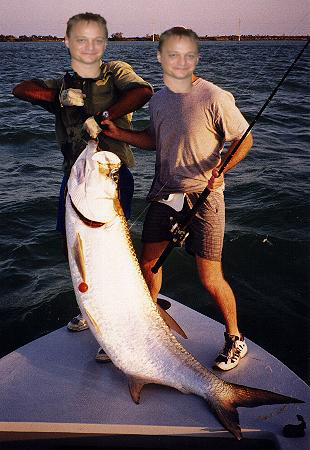 He surprised us more than once by playing possum and then taking off again, starting the fight all over. I almost knocked Darin into the gulf a couple times, almost crushed him when the fish ran under the boat and he was too close, and got really really sore after a little while fighting this fish.
We finally tired him out, and got him alongside the boat. He was amazingly beautiful. Darin gaffed him in the mouth, and we pulled him halfway out of the water – it was about all that was easy to do. We wanted to get a picture, but he was simply too big to get into the boat safely…so I was holding him by a gaff, over the side.
Darin got the camera off the console, and the fish suddenly wiggled with this full body shimmy – almost pulling me into the drink. His mouth came off the gaff in slow motion, and he slipped back down – vertically, and ever so slowly, fading down into the dark green waters of the gulf. Gone. But oh my – what a ride.
The point is, I could have stopped with the Goliath Grouper that night, and had an amazing story to share. But Darin gave me a fishing memory that trumped it – no less than an hour later. I went from huge, to huger. And huger still is out there – waiting for another day.
Since I didn’t get a picture of this guy, I modified one I swiped from online, so you can see what I mean by big fish…Tarpon are amazing creatures – I highly recommend catching them, at least once. Nothing like it.
So Recapping:
- Find a seasoned guide you can trust – someone who knows the waters
- Choose the right bait, and be willing to take the time to discover what actually works best and how to get it
- Allow your guide to bring you to the right place, and listen as they tell you how to cast and retrieve
- Be persistent and don’t allow a snag to make you stop – there could be a goliath at the other end of that line!
- Know that bigger fish are always there, and you can catch them too, with a slightly different approach and some experience
- Take Marty fishing more often…
I hope I have made it perfectly clear how an online marketing plan is exactly like fishing with my friend Darin for Goliath Grouper off Sanibel Island in Florida. Exactly, in every possible way.
Just wait until I get all amped up talking about sharks…
by Marty | Nov 27, 2010 | General Pearls of Wisdom
 I want to write a simple little post here, so forgive me if I verbally drool a bit in my zeal to say the right thing.
I am a little amped, because I am getting tired of idiots telling other people – idiots in training if you will – that it is easy to make money online.
Wait – calling the victims (suckers? customers?) idiots is not fair. Good people get caught in bad people plans all the time. Sorry good people.
Many good people get horn-swaggled by the shiny things: simply believing they are buying something that propels them in some miraculous way that makes effort unnecessary.
It’s not easy, and there are no magic products that make it so. None.
Trust me on this – I have been building stuff online for about ten years. I work regularly with some of the most respected people on the internet, and believe me, there is no magic formula, there is no secret, there is no hidden tactic that will unlock anything, beyond access to bank accounts.
The people I know who are successful got there because they are shrewd, work hard, and are willing to take a CHANCE.
Are you? (Taking a chance does not mean throwing money at something, and praying it works).
Stop it. Easy is a Dream.
Stop believing in internet unicorns, money for nothing and marketing fairy tales. Stop believing there is a way you just start cashing checks, simply because you want to. Just stop it, and start doing stuff.
Realize that drive and desire alone do not supplant experience, creative ability, and an honest network of niche-specific, seasoned professionals. Be willing to sweat, or lose some sleep for a while to build something better than everything.
Shut up, and keep your head down. I believe in this a lot more than i practice it, BTW.
Keep selling and buying – or whatever makes sense to understand the nuances of your marketplace, but just keep learning. Trust in your own experiences. Grow them exponentially. Emulate those you admire, but carve your own way. Make a splash, use your voice.
But above all, be a good person, and work hard. Because then, and only then, does the rest come easy.
by Marty | Nov 5, 2010 | Freelance SEO Copywriting Tips, General Pearls of Wisdom
How To SEO Blogposts
Got a great question in an email from a guy named John, asking:
Do you have a resource that can actually spell out (or at least provide guidelines) for how often to use a keyword in an article, and a little bit about placement for someone who is really green, but keen to get started?
 SoapBox Answer: The problem with looking for a reliable keyword-to-content ratio or set of guidelines, is there is none. Different niches and scenarios will bring similarly different results. One size cannot possibly fit all.
Keyphrase strength becomes an individually evaluated thing that flexes wildly. More importantly, this is only one thing (among so many) used to evaluate a site or page’s value. Concentrating on keywords and keyphrases alone is more likely to hurt you in other aspects, most commonly in general usability and coherence.
You also run a very real risk of a search engine filtering for over-optimizing, should you get too happy with repeating a keyword in a page or a link campaign.
When the keywords are the most important things, you lose track of why you are creating the web page to begin with, which is to engage readers. Step back a bit: it’s time to see the forest, too.
It’s true, the right keywords will work wonders, but it is infinitely easier for most people to figure out something that makes them special. Subject matter expertise is going to trump most keyword-driven shenanigans. Certainly, if you are in it for the long haul, this is going to prove true…give it time.
The Sad Truth: The Right Keyphrases Are Not Magic Pills
Ultimately for most people, keyphrases themselves just won’t help you like you think they will. You can’t plug them into your idea later on – normally, they should’ve been a part of your idea from the start. Pasting them on later is very difficult, and rarely effective – unless you are paying for it to happen, or guided by professionals. Better to chuck the idea of keywords at that point, and simply create better and deeper content for your readers, based on subject matter.
And don’t think there is a magic ratio, or keyword density or anything like that that matters. I promise you, there isn’t and it doesn’t. Anyone selling you a recipe including keyword density optimizing, is full of shit. There is no blanket approach that will work for you in every situation, there is no formula to attach to it.
Keywords are nuanced by niche activity.
No Ancient Chinese Secrets Here
You must only write things that connect to your audience for it to be effective. The emphasis on keywords is really displaced, because you need to focus a lot more on each page having a specific meaning to your visitors. But meaning is an esoteric thing, and hard to evaluate, or measure, or pay for. Yet it works – quite often, better than many keyword-originated strategies will.
Google is drastically changing what it is doing and how it is ranking things – so creating the assumed value around a keyword or keyphrase is as important as the words themselves, if that makes sense. Build meaning.
OK. But How Do I Optimize a Webpage for Simple Keyphrases?
That babbling disclaimery stuff all said, making sure you are amply covered for a specific keyphrase/keyword is easy.
- Include your keyword in your page title {This tells the search engines what the page is about}. Titles have been important for years. They continue to be…though, I personally have reason to believe a focus on page content over titles is a smarter move for staying power. I completely optimize every page title of important sites with a ton of care and time. Even on lesser sites, I make sure each one is unique at a minimum to make them work effectively. Aim for titles of about 70 characters, but don’t worry about counting your characters. Just write a decent title, and use your keywords in a realistically strategic way – nothing earth shattering needs to happen. The placement of keywords might be important, so value the left side as strongest, and create your titles with your main keywords coming up more immediately in the flow. There doesn’t seem to be one separator preferred over another (dashes, commas, colons etc.). Using less or more characters in a title does not seem to tip it either way on its own merit, though I admit never isolating it to fully verify this. Just a good hunch, here.
- Include your keyword thru your body copy{Use it both verbatim, and in various forms for greatest effect}. There is no set rule on where, and how much to use keyphrases – I veryloosely aim for the opening sentence, the middle of the page, and the conclusion if possible, at a minimum. Why? Because then the keyphrase occurs naturally thru the entire page. Emphasis here on “natural” appearance.
- Add a meta description that is meant for enticing readers, that is about two sentences, and includes the keyword again, naturally in the flow of describing the page contents. No big whoop. 30 seconds per page.
- Use various forms of the keyword to build a link campaign {Using the keyword and variations, create internal and external links to build power to the page you wrote-variations will help you deflect or minimize over-optimizing filters}. In your own site’s content, blog comments, article sites, or wherever you are building links, try to use the keyword and its various forms as anchor text. Mixing it up but staying on topic is a great strategy.
That’s it – rinse and repeat, ad infinitum. Never ends, but what a ride.
Final Ideas:
Don’t feel the need to buy anything. Products and memberships might come later, when you understand more. There is plenty to learn for free, on your own, before you start paying for a boost or joining a club. Test more, on the cheap – join less. Read tons.
Read – learn, and start websites. See if it -this work- really makes a good fit for you. Take in everything, but let experience guide you. Not every message is true or honest out there – and if you are trying to learn, getting swept-up believing in “easy” can cost you a fortune. Build sites, and test things. Be skeptical. Empirical data rules.
I’ll repeat: there is no easy. There are smart, hard workers that certainly succeed and emerge every day – but none of it comes easy. It is hard work, and smart moves. Pony-up, and roll up those sleeves. Unless of course, following those 4 steps above comes very easy for you – in which case, you should be both pleased, and insanely busy. More power to you. Milk it hombre, and you’re buying next time we meet.
There is never going to be a single product that makes web marketing easy. I think I gave you here, all you need to know to get started, provided you have something worth starting. The latter is the key point to chomp here: have something worth saying before you decide to start talking. {NOTE: talking to a friend, he said he disagrees here. He believes more in the get started, and let experience provide you something to say – which I thought was a good point. My own point, is geared more toward the folks I am seeing learning techniques in search engine loop-holes without having a deeper foundation in a business direction first. I am old, though, and cantankerous.}
I think you should have an airtight business plan before you plan on spending profits, or outsourcing anything. Start with a product to promote, not the process to promote.
No one cares about another Internet Marketer one way or another. Make them care about something you believe in personally, and you are on your way. No reason to shill: find a calling that suits you, and work into it slowly. Plenty for everybody out there, and you don’t have to scam to succeed.
Good luck – and I hope you forever avoid squishing into the unicorn poop of Internet Marketing.
by Marty | Oct 22, 2010 | General Pearls of Wisdom
In a great interview I was lucky enough to do with Tamar Weinberg for SEOBook, she closed with a quote that bears repeating (bold is mine):
Don’t spread yourself too thin. Try to build your presence where you know you can really make a difference, and branch out slowly if you want to experiment. Hopefully your marketing tactics will pay off to the tune of more business, more money, and the ability to hire more people who can help further your marketing message in the world wide open. 😉
Tamar is an excellent writer, so she knew what a clever phrase she was turning here. I know, because I asked her about it (making sure it was intentional), and she laughed, saying she debated leaving it in, but liked it. So do I – and here’s why.
I think Tamar is referring to two things: one) to marketing without limiting yourself by eWalls or other hurdles of personal construction; and, two) approaching the web – and marketing in general – wide open. Transparent. Willing to be what it is you are. Making an honest difference.
Both ideas are worth chewing on – thanks Tamar.
{Late edit: it made me a little sad to do some research, and learn Tamar wasn’t actually the first to say it. I love it no less.}
by Marty | Oct 9, 2010 | General Pearls of Wisdom
CosmicConnie had a tweet about a beautifully succinct post on the Examiner by Cassandra Yorge: http://www.examiner.com/social-change-in-national/a-moment-of-silence-for-the-victims-of-james-arthur-ray:
Last October James Arthur Ray killed three peoplein a sweat lodge. The deaths of Kirby Brown, James Shore, and Liz Neuman weigh heavy on my heart even though I never knew them in life. They should not have died. Their murderer should be in prison. The latest word is that James Ray’s trial will be in February 2011, at which point he will face triple manslaughter charges. Currently he is blathering away on YouTube. I ask you to join me for a moment of silence for those who died at James Ray’s hands.
[ ]
Ok, enough for silence.
How about a little outrage now?
I want to honor the victims who died at the hands of this horrible cretin, and help to stop other horrible cretins from getting the chance to do harm. All I have is a voice though, so I am willing to use it because a thing like Sedona should have never happened.
And why did it happen? Among the many things that will no doubt be argued in court as murderer James Arthur Ray faces his crimes, at the bottom of it is greed. Filthy, despicable, self-aggrandizing greed.
It is this that I want to use my voice against, it is this underlying greed that I want to admonish. In my own way, it’s how I want to honor the victims of James Ray today.
Greed treats individuals like a number or a cog. There is no respect nor a shred of basic human dignity offered toward “the mark” – they are simply evaluated for net worth, used-up, and discarded…and another is deftly slipped in to the still-warm, empty spot.
It is a vicious cycle, and one that preys on you. You are particularly in danger when you are looking for help, or guidance – like Kirby, James and Liz – for greedy opportunists understand there is a monetary value in convincing you to believe there is always something better coming soon- and this thing, this one thing, might be just the thing you need to get there.
Yet what they deliver, because it is the only possible thing to deliver to such an absurd promise, are Magic bullets and unicorn dreams to distract you from the fact they are figuring out your net worth to lubricte the cycle. By the time you might begin to notice it is not your best interests being protected or even considered at any point, you might find yourself dead in a sweat lodge.
The greed of James Ray was no doubt a big part of what drove him to cut corners in providing adequate resources in Sedona. He was no expert, and this was a dangerous thing by any measure. But he still created a sweat lodge and killed people in it.
3 of them: Kirby, James and Liz.
These are not the only deaths being attributed to James Ray and his greed. Hopefully by the time the dust settles in court, they find or invent very interesting ways to punish the guilty.
Today, James Ray is tweeting. Obscenely, others have families that are mourning and there are (at least) three of them.
The families of Kirby Brown, James Shore, and Liz Neuman.
I will join those who remember what you did to these people, James Ray. I will use my little voice to say it again, because it ALWAYS bears repeating: James Authur Ray is responsible for their deaths. He killed people with his selfishily irresponsible greed.
No doubt, James Ray will rot in whatever hell exists. Because no matter what happens next: he killed people.
While there might never be a way to understand the deepest mechanics of why it happened, how it happened is definitely worth examining by the proper authorities. And remembering is important to the survivors, and the families of those lost.
And punishing this charlatan is important to send another message that there is a system of checks and balances. So is speaking up, and speaking out against it. I look forward to justice being swift and heavy-handed.
I want to honor the families of the victims of James Arthur Ray in the Sedona tragedy last year. I am so sincerely sorry for your loss. May you soon find peace. Please let my voice join with those that already offer you support. What happened matters, and we lift our voices to remember with you.

 But I did come up with a decent enough running metaphor about this fishing trip. Let’s call it an online marketing plan. Just substitute it.
 e best bait I have fished with, I think. Everything hits them, in the same way that everything hits a shrimp-however, the types of fish, and potential for big ones is infinitely better with Ballyhoo, in my experience. Could be where we are fishing. But I have caught so many different species using them, I am convinced they are a great hidden secret.
 in the line, so he could flip off.