by Marty | Feb 12, 2010 | General Pearls of Wisdom
I have the unfortunate experience to have a lot of domains hosted in GoDaddy.
There are many reasons I don’t really like using them, but the fact remains I have a lot of domains there.
But I have seen one thing they do that I want to warn everyone about – beware of GoDaddy scamming your domain.
Here’s What Happens
Let’s say you have a domain registered in GoDaddy, and want to set up a blog in Blogger. Cool – Blogger gives you instructions on how to change the C record and the A record to make it work.
So this is what I did. And when I looked at my site an hour later, it looked like this, which was good:

Everything cool. The blog worked, the domain seemed ok and the instructions from Blogger seemed to do the trick.
So I thought, anyway.
What I found a few weeks later when I was getting ready to return to this site was pretty shocking.
You see, I wanted to go to the site but I forgot to type in the www. Simple mistake. And usually, if I am setting up a site in normal situations (not using Blogger), I set both the www and non-www to work seamlessly.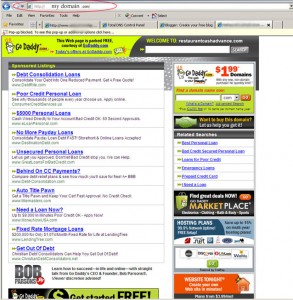
But no – I saw this – and if you don’t know what this is, it is a PPC page. This means it is something GoDaddy set up to run on my domain.
What it does, is display ads that other people pay to have displayed on certain keywords. The domain I had concerned small business money, so look at how it matches the subject matter.
Needless to say, I was pretty shocked. This was not a parked domain mind you – it was live. I couldn’t believe what I was seeing, but figured it must have been my fault somewhere in the settings – I was not terribly used to Blogger, so I could have missed something.
Nope.
The GoDaddy Sham Deepens
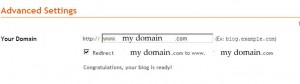
There was something wrong with the canonical set-up, but I had it set up correctly, as you can see to the left here. Blogger makes it so you can correct any canonical errors – meaning, the www and non-www versions of the site would be the same.
This made me more concerned. If I had this set up correctly, and my A and C records were properly set up, why was this happening?
I looked at the source code and found: 
Now I realize most people don’t read code, so this means that GoDaddy placed an AdWord campaign directly on my domain, targeting relevant keywords in a broad match manner. Since my domain was about business money, the ads were about business money-so my competitors can suddenly get clicks from MY DOMAIN. GoDaddy gets paid for every click.
Keep in mind too – I bought “myDomain.com” not the www version. GoDaddy was using the domain I bought and set up as my blog.
The GoDaddy Response (or Lack Thereof)
So by now, I am pissed. I write an email to my rep – and I have an executive rep over there because I have so many domains. I kinda feel sorry for him really – he is new to my account, and this was really our second interaction.
But since I was mad, I write the email and let it sit for 4 days. I had all the same images I have here – just not blurred out – and basically, but very directly, asked for an explanation.
I send it, and wait for my response. And wait. And wait.
A week later, I re-forward my original complaint and demand a response.
Finally get a one-line email saying I need to go into the account and delete the C and A record settings and forward the domain to the www to make it work. My original complaint asked about whether or not I now needed to check my other 100+ live sites to make sure this is not happening everywhere – crickets.
Every bit of my complaint ignored – handled by this one-line response. Pathetic.
Why This is So Shady
The reason this chaps me so much, is not for my own situation but what it represents. GoDaddy is a huge registrar…and they do more aggressive advertising than any other. So they’ll attract people who know nothing about the web, but want to get started.
I know what I am doing more than a lot of business owners would, and still did not catch this canonical error. By the time I did, this scam had been running for months. When I looked for help, I was ignored. I had to demand a fix.
GoDaddy was paid for my domain. They then hijacked it, and profited further by sending potential leads I might have received to my competitors.
Shameless.
It makes you wonder how many sites are unassumingly being compromised and swallowed by GoDaddy’s greed?
by Marty | Feb 8, 2010 | Freelance SEO Copywriting Tips
I am a big fan of the Showtime Original series, “Dexter.” If you haven’t seen it, it is a show where the main character is a forensics blood-spatter expert by day, serial killer by night.
In the first season, Dexter manages his balance between these two extremes by rigidly following “the Code” which is a set of rules his father Harry established to protect Dexter. Harry’s Code acknowledges Dexter’s need to kill, and sets forth a rigid set of rules that MUST be followed, or else Dexter increases his risks of getting caught. Learning Harry’s Code is what enables Dexter to find and begin to practice his “art.”
However, as the seasons of this show progress, the audience sees Dexter questioning the need of Harry’s Code, and he looks to find his own answers. Amazingly, if you watch a season or two you’ll find yourself rooting for a serial killer to find himself, and achieve his murders without being caught. Really fun stuff, and wonderfully addicting.
I want to suggest that in writing corporate communications, Dexter makes a killer metaphoric role model.
- Harry’s Code: Think of grammar rules as the Harry’s Code of corporate writing. There is a fixed set of rigid rules to follow that guarantee safety. Like Dexter, if a writer follows the Code (rules of grammar) religiously, chances are pretty good they will always find safety. Learning and understanding the Code is a necessity to enter into the life we choose. Like Dexter, the Code needs to become intrinsic to your very being, so a violation of the Code immediately sends up a distress signal. As Dexter’s character grows, he starts to question the code, and test it. He knows the details of Harry’s Code as if it were twisted in his DNA, but he starts to use experience and desire to carve out his own set of rules. The results are not always good, but they start to establish Dexter as a character that is separate from Harry’s influence – or in metaphor-speak, a writer with a uniquely competitive edge. Kick your grammar lessons to the curb and see what happens. Breaking away from the codes and traditions that get us to where we are is not easy – but it is often necessary to achieve the unique character that keeps us successful season after season.
- Research the Kill for greatest impact. On the show, Dexter’s success comes from the fact that he is a very methodical serial killer. He does extensive research on each target, and understands and prepares the situation as well as he can before he engages. His planning is framed on his understanding of Harry’s Code and his own experiences. There is nothing casual or random in how things unfold: Dexter intimately learns the personal habits of the target and he uses the environments to carefully plan every detail so it goes without a hitch. He does not force his ways blindly onto every situation, but instead, he uses experience and patience to ensure he will strike only when he gets the strongest return. Many times, if all the elements do not align, he will wait for better circumstances to more effectively manage his risk. There is an eye fixed on the end result and passion drives the process, but only restraint, control, and discipline allow him to be at the top of his game. When things do line-up, which they always do in time, Dexter goes in (very precisely) for the kill. Passion inspires him to find what he needs. Research and attention to detail are what he uses to uncover opportunity, which in a sense, his passions are constantly proactively creating. Dexter is very plugged-in to his art and builds on each experience to become more effective. Every kill has purpose, he is always striving to be better. Even when he seems to be simply catering to his “needs,” he is perfecting his art by testing and tightening the routines, validating the power of Harry’s Code by either using it, or deliberately choosing not to. As writers, the metaphoric lessons Dexter’s carved out for us here are clear.
- Don’t be afraid to change. One reason the series continues to be so successful (in my opinion), is that Dexter’s character is growing and changing. As the world around him morphs, he adapts. He is trying new things, and his character is allowed to become deeper. At his core, the things we loved about Dexter remain: he is a killer conflicted by his immenent “dark passenger” – the need to kill – and what it does to him. His story unfolds in the very elaborate efforts to ensure a guise of normalcy while keeping the dark passenger entertained. After we are introduced to the safety offered by rigid attention to the details of Harry’s Code, we see Dexter shed it to find his own meaning. His quest seems to always bring him close to the magic elixir, but he has yet to find his perfect balance and complete his hero’s journey. We see him try and fail but try again, and all the while he is changing, growing and evolving. Writers need to be like this, and find the work that excites them enough to change. Test the limits created by of your own version of “Harry’s Code” (grammar rules, using slang, etc.) and see where it lands you. Pitch the rules, and start over. Let the past shape you, let the rules point you in the right direction, but don’t allow convention to dictate every step of your path.
Ok, so maybe a serial killer is not the best role model.
But in corporate communications, people talk all the time about “killer copy” and headlines that kill it. I argue that this is only possible when like Dexter, you understand enough to avoid normalcy. You must embrace the Code long enough to earn the right to use experience to discard it at will. And above all else, you must be willing to adapt, change and grow to keep the audience engaged.
Work with me, people.
by Marty | Feb 5, 2010 | Freelance SEO Copywriting Tips
In completing a few things on the boil this week, I just sent off a couple guest blog posts. They were really fun to write, and I hope they do well for us all. I also just tucked-in to a 17 page word document of new site content I am writing for a frame shop in Wisconsin – going to be reading and tweaking until my eyes slam shut tonight. Have an ad concept meeting on Friday, and gotta get a new statement of work together for a new project.
This made me think of the different types of work I have done recently, all of it tied in some way to SEO copywriting. I am going to list them here, and encourage you to use this as a reference if you are trying to figure out who might need your services:
- Site content. Ah yes, the staple of our trade. Businesses ALWAYS need site content. But in this case I refer to the core pages of a site, the skeleton of someone’s corporate message. There is always a new business idea seeking the right presentation or a tired business needing a new idea, so as a writer, you can make a huge impact on a successful launch (or re-branding). If nothing is jumping out at you for where to find work, go where your passions lie and see who needs help. Ask, and ye shall find. Working on the right project recharges your batteries, and more experience (both good and bad) makes you ready for bigger and better projects.
- Ad copy. Static ad copy that works is a very valuable thing. Making the most of a medium is key here, so if you have specific experience (e.g., in AdWords, Local Search, banners, Facebook, etc.) it is no crime to mention it. Writing tight little ads for Adwords, Facebook, or other specific mediums is bank. Proof of your mastery is visible in days (in many cases). If you have experience (and no non-compete agreements to prevent it), look to the niches where you have already found success. Build on it. Ad copy (of the Adword variety here – not speaking of more traditional ad copy) is not usually something I land as a gig on its own, but I lump it into a larger web project quite often.
- Blogposts.Yes, blogposts. As I said, I have been doing some guest posts lately which have been fun. Sometimes I even write as me now! But I also write a lot of corporate style blogposts anonymously. Businesses appreciate all styles of writing for blogs, so find the tones where you are most comfortable and offer your services, if appropriate. If you like a blog, you can also just write a guest post and offer it – most people would love to have something authored by an expert, so get out there. If they reject your guest post, they may offer suggestions on what to do to bring it up to speed for them – it rarely hurts to try, anyway. Blog owners like having a day off where the content still flows. It works for you in strangely wonderful ways sometimes.
- Press Releases.Press releases are gold for most small businesses. A press release is a legitimate way to spread positive propaganda about your business, and you can reach a really large audience very quickly if you handle it correctly. Knowing how solid press releases are written is a bankable skill in any industry. These are one of my favorite things to do, really – I find them incredibly easy, so I can spend a good deal of time strategizing the SEO and making them work really well. I have written press releases for auto salvage yards, doctor’s offices, financial providers, service providers, an international overhead door company, geospatial imaging specialists, architects, veterinarians, life coaches, a Vespa scooter dealer and more. All businesses have news, and knowing how to properly leverage a press release is a search engine strategy that still packs a mighty punch.
- Product descriptions. Last year, I wrote catalog descriptions for two large-scale retailers. What it does for them, is it gives each product page more meat so the search engines appreciate the site a little more. It is a great strategy to pull in more long-tail searches. For me, it was good, steady work for months at a time. There are lots of businesses that can benefit from unique, focused product descriptions – the difficulty I have experienced, is usually more about finding someone willing to pay what it costs for creating that many pages. (But many business owners understand the power here, and know a moderate investment now pays for itself repeatedly over time). Not the most glamorous writing gig for some people, but I actually like the rhythm of it once I get the corporate tone in stride – kind of like riding on a train while you work. Some companies like really unique product descriptions too, so it is a lot more creative than most people might think. Sometimes.
- Articles for article sites. A 200-800 word article on a specifically identified topic can help a business in their search engine efforts. I worked on a couple strategies recently that involved creating articles for article sites, so the embedded links could be leveraged from a topic aligned with the client’s business. The pay level is not usually high for this kind of thing, but it is something I can bump out without much effort. One important thing to know if you are not aware: power writers on article sites will get the love. If you are a freelance writer and don’t have many active clients, look to these article sites and aim to get enough solid material in one to raise your status to a power contributor. Personally, I don’t think enough of article sites any more to spend time developing my own profiles to gain power from them – I have other fish to fry. But I certainly have written my share of articles for these sites, and it is a strategy many businesses will hire you for. And if you become a power author, you have clout that can earn you some bank from what I understand.
The point of this list is to consider where you could target people looking for this kind of SEO copywriting. Or, if you are talking to someone about the possibility of hiring you, you might mention some of these as options for potential projects.
One last thing to think about from this list, is how widely varied the SEO copywriter’s tool chest can be. You can easily make a specialty out of any one of the things I listed above – or like me, you can go where they need you most.
Call it one small step for job security!
by Marty | Jan 22, 2010 | Work Tools
http://www.opensiteexplorer.org/
This neat little site explorer tool was released this past week by SEOMoz.
It’ll help you to do competitive research or learn more about your own site, and where you might be able to build some power into it.
I’ll add more to this post after I have had more time to play with the tool, but it is pretty swift. Highly suggest checking it out if you are into SEO copywriting – there is a ton to learn in here.
To get a better idea of what this tool can do, Rand Fishkin, the Big Cheese at SEOMoz wrote this post full of details and explanation.
On another site, I actually asked Rand about the site metrics, which he responded to almost immediately.
My thinking, is that in time, this tool will become very popular, especially in SEO circles. Go check it out!
(tell ’em Martypants sent you!)
Later observations:
- The tool has a really nice interface and is very user-friendly. Pretty easy to figure out, even if you have limited SEO experience.
- The clear indications of 301s and no-followed links gives some great “at-a-glance” info
- (Entry date: April 17, 2010): I am realizing I use this tool mostly for some large overview glances into competion. I do not have a pro membership, so my results from my free account are limited. They do help, and I do think of this tool in my natural work flow now. I like the look at link profiles to see where I stack-up against the people I am looking at. I don’t get much value from some of the data (seem a bit abitrary, but if used as a constant in comparison and analysis, I guess they offer some degree of competitive insight), and referred to this tool probably 3-4 times. I will give it props though – it does offer value, even at the free level. And the sales tactics used to try to upsell don’t impede anything, so it is well presented in that way. For a free tool, it is one of the better ones out there in the SEO world, to me. That said, I use my SEOBook tools much more often, and still rely pretty heavily on them. Go figure! 🙂
- (more to come…)